Omnidirectional
- 360 video
The camera sees in every direction at once.
Opens a video model with the prompt in it. The price is on the page before you sign in.
What it is for
The camera records every direction at once, so nothing is outside the frame. The viewer chooses where to look instead of the director choosing for them.
That hands away the oldest tool in filmmaking. There is no off screen, so tension built on what the audience cannot see has to be built some other way.
It also changes who directs the shot. The person holding the camera decides where it stands, and the person watching decides what it is about.
How it works
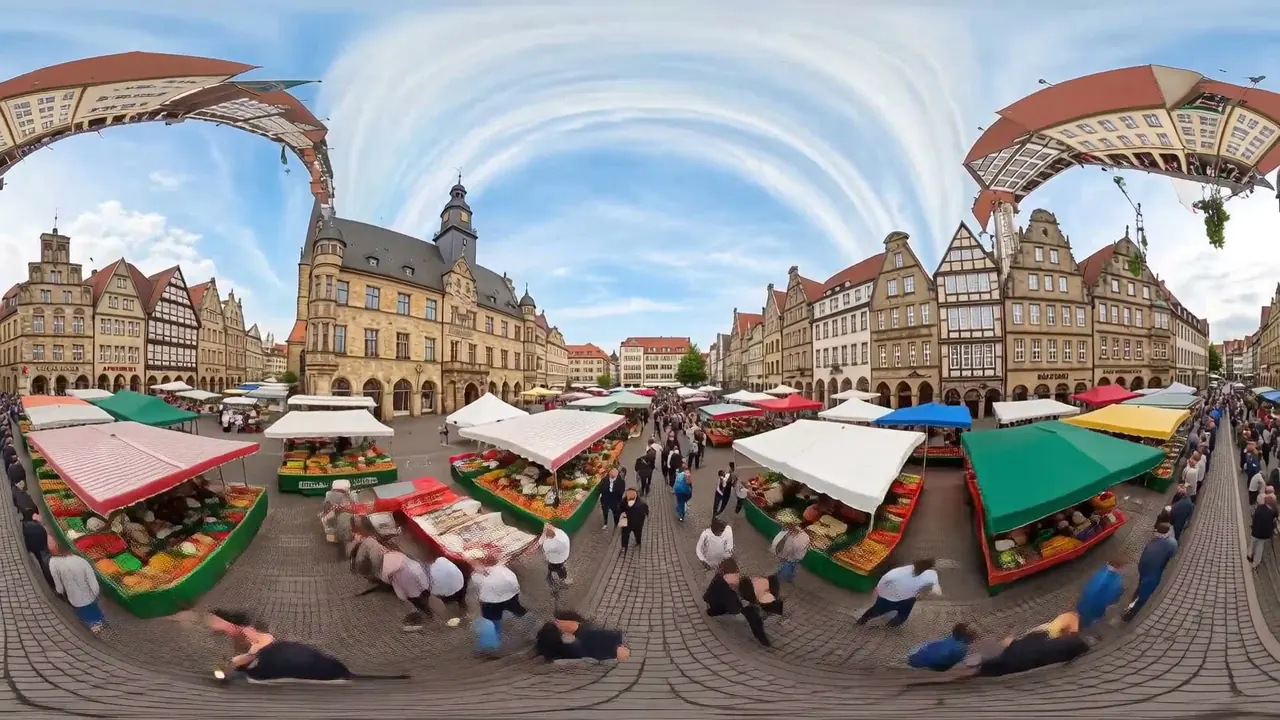
Several lenses cover overlapping fields and the images are stitched into a sphere. The usual delivery is an equirectangular frame, which is a flat rectangle holding the whole sphere, stretched hard at the top and bottom.
The stitch lines sit where the lenses overlap, so anything crossing them can tear. Keeping subjects away from the seams is a real staging constraint.
There is nowhere for a crew to stand. Everything within sight, including the tripod, is in the shot, which is why the rig is usually removed in post.
Height and position matter more than framing, since there is no framing. The camera sits where a person would stand, because everything in the sphere is measured against that point of view.
When to use it
Use it for virtual tours, headset viewing, live events and anything where being present in a place is the point.
Skip it for storytelling that depends on framing. Composition, the cut and the reveal all lose their grip when the viewer can look away.
It also changes how long a shot runs. Viewers need time to look around, so a shot that would play in three seconds usually needs ten or more.
Told apart from its neighbours
A 360 degree orbit moves one camera around a subject and still delivers an ordinary rectangular frame. An omnidirectional shot does not move at all and delivers the whole sphere.
One is a path. The other is a format. The word 360 appears in both names and means something different in each.
The prompt
Replace the blanks, keep the rest. Then run it on a video model.
360 degree view around <subject>, full surround, everything visible at once, equirectangular framing
What goes wrong
A flat render of a spherical capture looks like a distortion rather than a technique. Say the output is 360 and name equirectangular framing, so the stretch reads as intentional.
The second failure is a normal wide shot with a 360 label. State that everything is visible at once and there is no single direction the camera faces.
A third problem is a composition aimed in one direction. Say the scene surrounds the camera and name what is behind it as well as in front.
A fourth problem is a crew or a rig left in the sphere. Say the tripod and the operator are removed, since everything within sight is inside the picture.
Leave out
single direction, crop
Watch for
Say the output is 360. A flat render of a surround shot looks like a distortion.
Questions
Shoot it
Pay for the one run. No subscription, and the price is on the model page before you sign in.
Next to it in how the camera is carried