Night Vision
A low-light sensor renders everything green and grainy.
Opens a video model with the prompt in it. The price is on the page before you sign in.

What it is for
The picture is green, grainy and blown out, and it tells the audience that whoever is watching can see and whoever is being watched cannot. The imbalance is the whole effect.
It also reads as a record. The look belongs to helmet cameras, security systems and military footage, so a frame shot this way arrives with a claim that it was captured rather than staged.
How it works
An image intensifier collects the small amount of available light, multiplies it, and throws the result onto a phosphor screen. The output is green because the eye separates detail best in green at low brightness, so the tube was built that way on purpose.
Amplifying that hard also amplifies noise, so the image carries heavy grain that dances frame to frame. Any bright source in the scene overwhelms the tube and clips to flat white, which is why highlights blow out and bloom.
The circular vignette comes from the tube itself, which is round, and the frame is square. Many devices also add a faint scan or honeycomb pattern, and the scene is usually lit by an infrared illuminator the camera can see and nobody in the room can.
When to use it
Use it for surveillance, for a scene in genuine darkness, and for any point of view where the watcher has an advantage over the watched.
Leave it out where colour carries meaning. Night vision throws all of it away, so a scene that depends on what colour something is cannot be shot this way.
Told apart from its neighbours
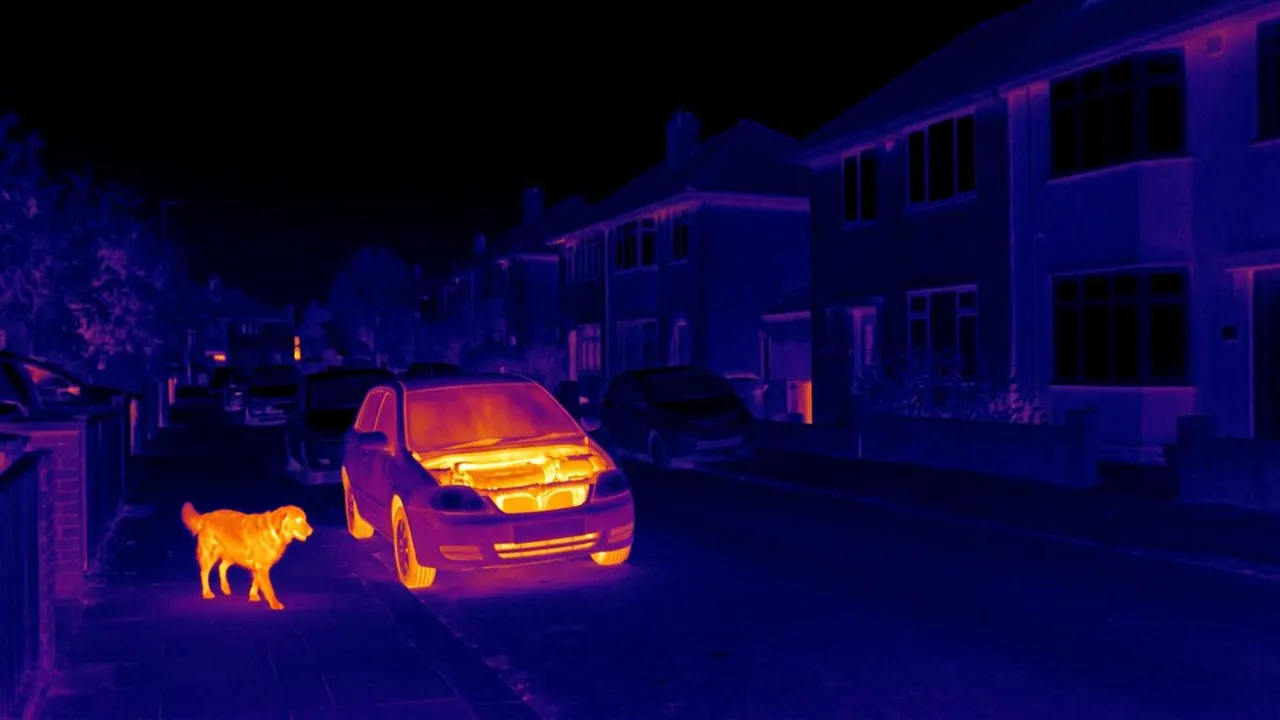
Thermal maps temperature and needs no light at all, so it shows a warm body through total darkness and shows nothing about a cold object however bright it is.
Night vision amplifies light that is already present, so it still shows reflectance. The test is a cold white object in a dark room. Night vision renders it bright. Thermal renders it dark.
On film
Jonathan Demme puts the last sequence of The Silence of the Lambs (1991) in a pitch black basement, with the killer wearing goggles and Clarice Starling feeling her way along a wall. The audience sees through his eyes, which is what makes the scene unbearable.
- The Silence of the Lambs (1991)
The prompt
Replace the blanks, keep the rest. Then run it on a video model.
night vision view of <subject>, monochrome green, heavy grain, blown highlights, circular vignette, surveillance framing
What goes wrong
The result is a correctly exposed scene with a green tint over it, which fools nobody. Blow the highlights, because correct exposure never reads as night vision.
The second failure is a clean image. Ask for heavy grain that moves, a circular vignette and clipped bright areas, and say the whole picture is monochrome green rather than tinted.
Leave out
colour, clean image
Watch for
Blow the highlights. Correct exposure never reads as night vision.
Questions
Shoot it
Pay for the one run. No subscription, and the price is on the model page before you sign in.
Next to it in seeing what the eye cannot