Origami
The world is built from folded paper with visible creases.
Opens a video model with the prompt in it. The price is on the page before you sign in.
What it is for
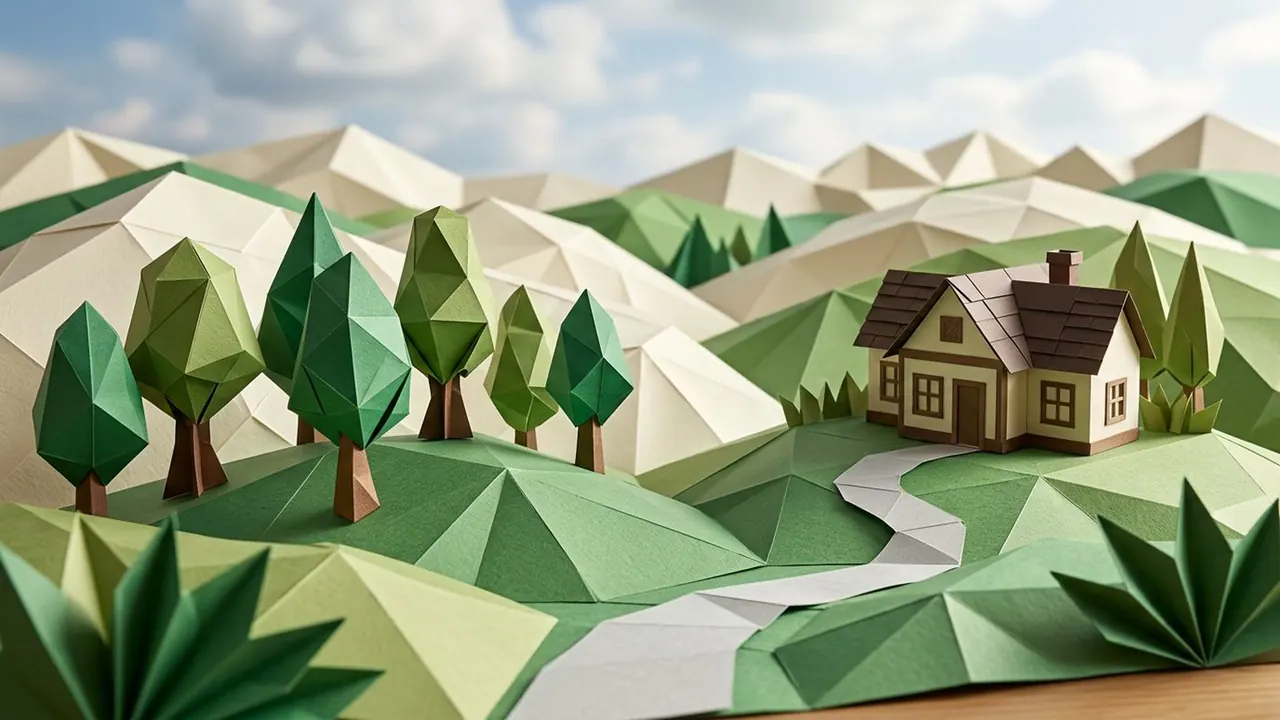
The world is rebuilt out of folded paper. Every surface is a flat plane, every join is a crease, and the subject keeps its shape while losing everything soft about it.
Folding has rules, and the eye knows them. A shape that could not be folded from one sheet reads as wrong even to somebody who has never folded anything, which is why the look has to be consistent to work.
How it works
Paper only bends along a crease, so every form is made of flat planes meeting at hard angles. A curve is impossible, and that limit is what makes the look convincing.
Creases come in two directions. A mountain fold points toward you and catches light along its ridge. A valley fold points away and holds a line of shadow. Both together give a folded form its depth.
Paper has thickness. A visible white edge where two planes meet is a small detail that separates folded paper from a low polygon model, which has no material at all.
When to use it
Use it for a stylised world, a title sequence, or a scene that should read as gentle and made. Animals, plants and simple architecture all fold well.
Skip it for faces that need expression. A folded face has flat planes where the soft parts should be, and it cannot do subtlety.
Told apart from its neighbours
Paper is torn flat layers lying over the picture, with the photograph continuing underneath. Origami replaces the subject itself with folded forms.
The check is whether the paper is the subject or in front of it. Creases and planes making up a figure mean Origami. Ragged layers covering a figure mean Paper.
The prompt
Replace the blanks, keep the rest. Then run it on a video model.
<subject> and the surroundings built from folded paper, visible crease lines, flat planes meeting at sharp angles, paper edge thickness
What goes wrong
Curved surfaces survive, usually on faces and bodies, and the effect falls apart. Ban curves by name and ask for flat planes meeting at sharp angles.
The other failure is a smooth plastic finish with creases painted on. Ask for visible paper edge thickness and a matte paper surface, so the material reads as paper rather than as a render of one.
Leave out
curved surfaces, soft texture
Watch for
Ban curves. Paper folds to flat planes, and curves give the effect away.
Questions
Shoot it
Pay for the one run. No subscription, and the price is on the model page before you sign in.
Next to it in painted, drawn and printed