Food photography
- food styling photography
- restaurant photography
Soft back light for steam and gloss, a 45 degree camera, and a plate built rather than cooked.
Opens an image model with the prompt in it. The price is on the page before you sign in.
What it is for
Food has to look edible, and two things say edible: steam and gloss. Both are made of light which comes from behind the plate and travels toward the lens. Front light kills both, because a highlight only appears when the source is behind the surface it lights.
The second half of the job happens before the camera. Food collapses, melts, dries and goes grey inside minutes, so a plate for a picture is built rather than cooked. It is undercooked so it holds shape, brushed for gloss, and assembled facing the lens.
How it works
Put the light behind the plate and a little to one side. A window is the usual source. Then fill the front with a white card, so the near side is not black.
Choose the camera height from the dish. 45 degrees for a plate a person would sit in front of, straight overhead for a flat dish, a spread or a board. Use a 50mm or a 100mm macro at f/2.8 to f/4 and say only the front edge is sharp.
Say the food is built. Name the gloss, name the steam, name what sits on top, and say the plate is wiped clean at the rim.
When to use it
Use it for a menu, a recipe, a packet, a delivery listing, a restaurant page, anything where the picture has to make a person hungry.
Leave it alone for a full table scene with people at it. That is a wider lens and a different light, and the plates become props.
Told apart from its neighbours
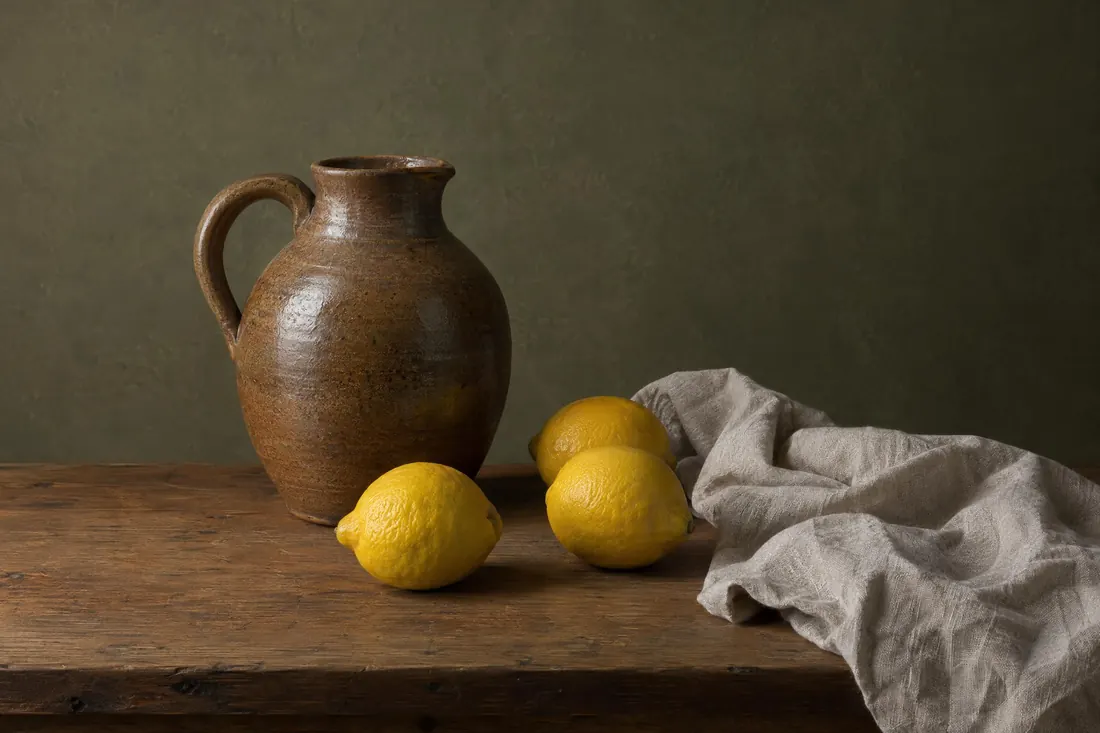
Still life photography arranges objects for their own sake at f/16 and holds everything sharp. Food photography arranges for appetite at f/2.8 and holds almost nothing sharp.
A flat lay in the commercial set shoots straight down on a plain ground, and it treats the food as graphic shapes. The 45 degree food frame sits the viewer at the table instead.
Macro photography goes to 1:1 and describes one crumb. Food photography stays at the scale of a plate, and only borrows the macro lens for the working distance.
Where it is used
Commercial food work has used stand-ins for decades: mashed potato for ice cream, motor oil for syrup, a steamer held just outside the frame, glycerine sprayed for condensation. The overhead flat lay became the default on Instagram after 2012 and pushed the 45 degree frame into recipe books and menus, where it still does the job of putting the viewer in a seat at the table.
- recipe books
- restaurant menus
- overhead flat lays on Instagram
The prompt
Replace the blanks with your own subject, keep the rest. Then run it on an image model.
<dish>, food photography, soft window light from behind and slightly to the side, a white card filling the front, camera at 45 degrees and close, 100mm macro at f/2.8 with only the front edge sharp, steam and gloss catching the back light, the plate built by hand on dark linen
What goes wrong
The dish comes back lit from the front, flat and dull, with no highlight anywhere. Say soft light from behind the plate, and say a white card fills the front.
Everything on the plate comes back sharp and the picture reads as a catalogue. Say f/2.8, say only the front edge is sharp, and say the back of the plate falls away.
Leave out
flat frontal light, a wide angle lens, a cluttered table edge, harsh overhead flash
Watch for
Back light is what makes food look hot and wet. Light from the front makes the same plate look like a menu board.
Questions
Shoot it
Pay for the one run. No subscription, and the price is on the model page before you sign in.