De Stijl
- Neoplasticism
- Mondrian style
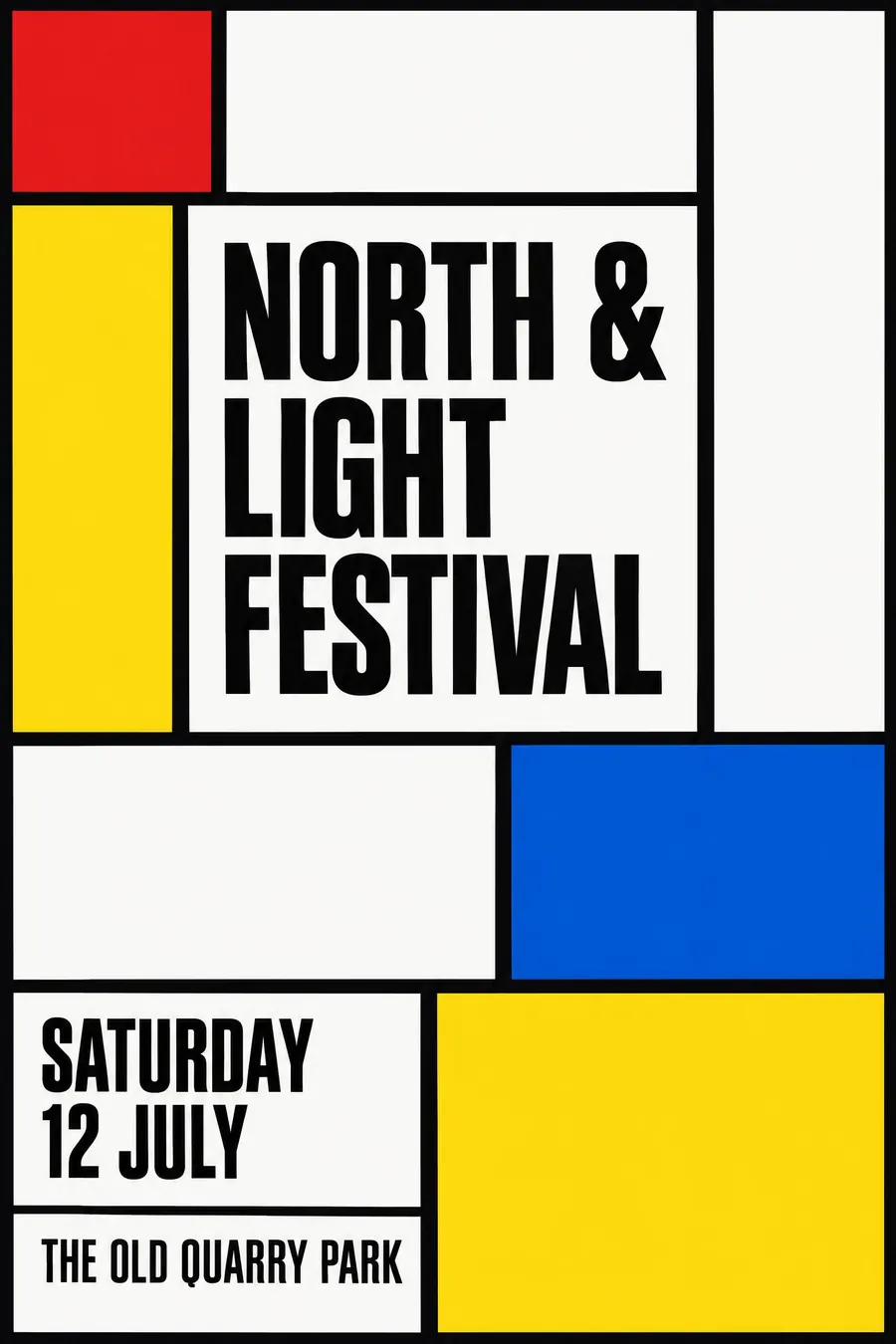
Black rules, white fields, and three primary rectangles. Nothing else.
Opens an image model with the prompt in it. The price is on the page before you sign in.
What it is for
De Stijl is the most restricted style in the catalogue, and the restriction is why it reads as confident. A poster that uses five elements looks like it chose them.
It is also instantly legible at any size. Three colours and a black grid survive a phone thumbnail better than almost anything else here.
How it works
Divide the sheet with black rules, horizontal and vertical only, into rectangles of clearly different sizes. Never a diagonal, never a curve.
Fill three of those rectangles with flat red, yellow and blue. Leave the rest white. Keep the coloured blocks small relative to the white.
Set the type in black inside one rectangle, condensed geometric sans, and give the detail lines their own rectangle rather than floating them.
When to use it
Use it for a design event, a gallery, a modern music night, a school open day, anything that wants to look sharp with almost no assets.
Leave it alone when you need an image. The style forbids illustration, so there is nowhere to show the thing you are advertising.
Told apart from its neighbours
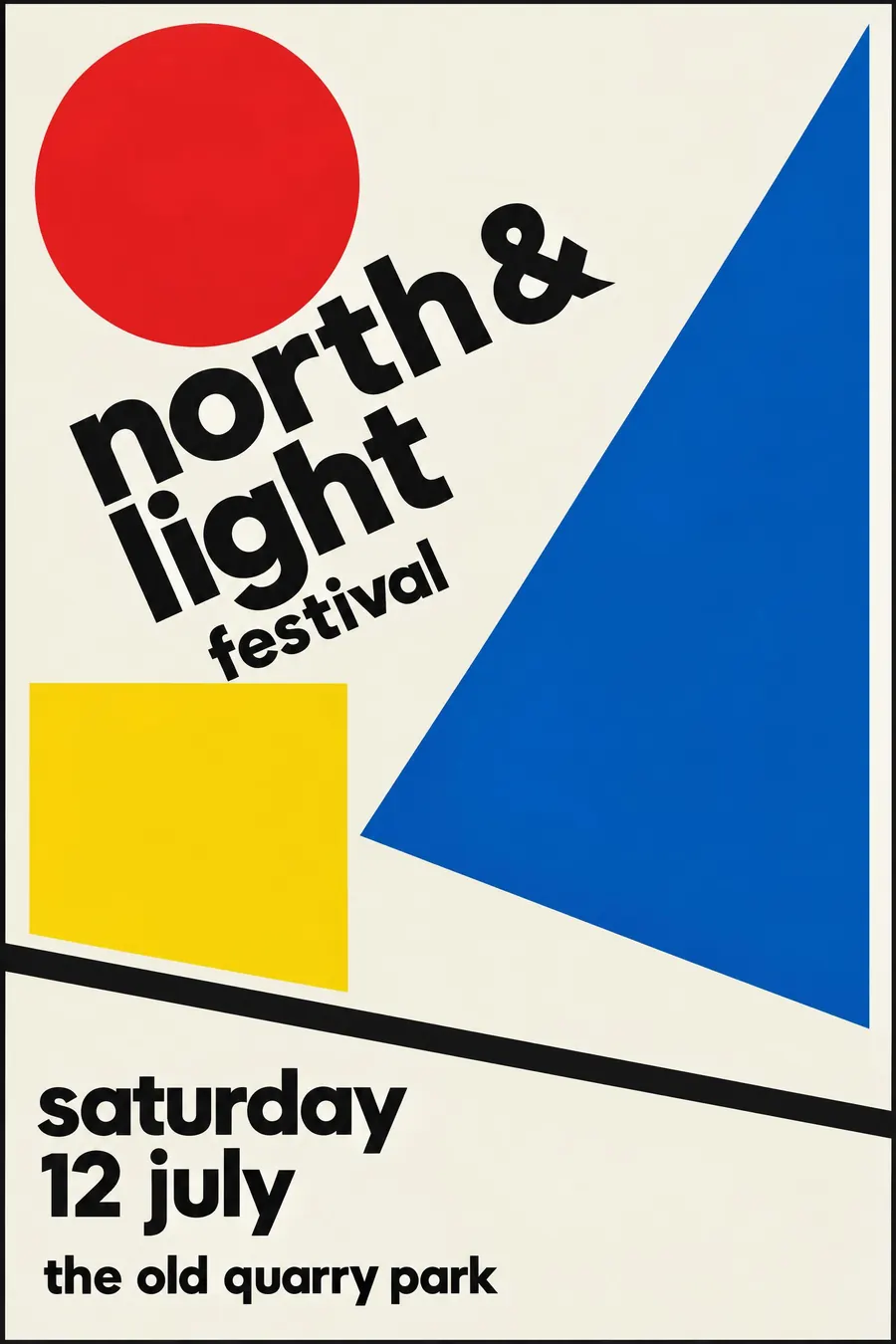
Bauhaus allows circles, triangles and diagonals. De Stijl allows none of them, which is the fastest way to tell the two apart.
Concrete Art comes later from the same root and allows more colours and more complex geometric systems.
Swiss Style uses a grid too, but as invisible scaffolding for photographs and text. Here the grid is the picture.
Where it was used
Piet Mondrian arrived at the vocabulary around 1920 and never left it. Theo van Doesburg ran the De Stijl journal, whose covers are the graphic version, and Gerrit Rietveld built the same grid as a chair in 1923 and as the Schroder House in 1924.
- Piet Mondrian
- Theo van Doesburg
- Gerrit Rietveld
The prompt
Replace the blanks with your own event, keep the rest. Then run it on an image model.
poster for <event>, De Stijl neoplasticism, composition of black horizontal and vertical rules dividing the sheet into unequal white rectangles, three blocks of flat primary red yellow and blue, no diagonals and no curves, condensed geometric sans in black set inside one rectangle, <date, time and place> in a separate small rectangle
What goes wrong
The model returns a Mondrian painting with a title typed over it. Ask for the type to sit inside its own rectangle, in black, as part of the grid.
The other failure is a neat grid of equal boxes. Say the rectangles are clearly unequal and most of the sheet stays white.
Leave out
diagonals, curves, illustration, extra colours, texture
Watch for
The rectangles must be unequal. Equal boxes read as a chart, not a composition.
Questions
Print it
Pay for the one run. No subscription, and the price is on the model page before you sign in.
Next to it in geometry takes over