Concrete Art
- Konkrete Kunst
- Max Bill style
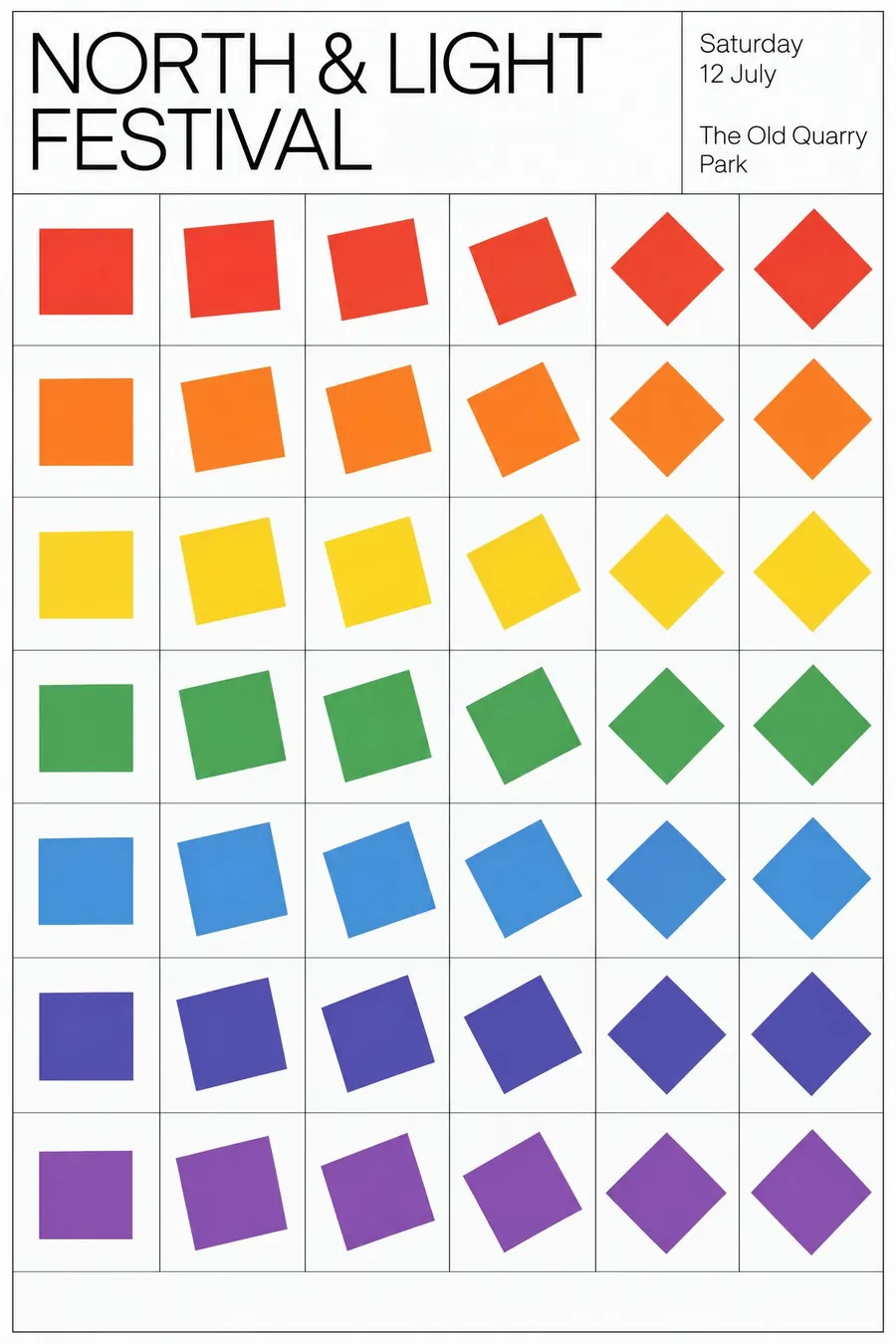
A visible mathematical system: a grid of shapes built by a rule you can work out.
Opens an image model with the prompt in it. The price is on the page before you sign in.
What it is for
Concrete Art makes a poster look intelligent because the reader can sense there is a system even before they find it.
It also scales. Once the rule exists you can generate a whole series of posters from it, which is why it keeps being used for festivals and concert seasons.
How it works
Pick a rule and follow it visibly: each square rotates five degrees more than the last, each bar is one module longer, the colour steps through a sequence.
Keep the execution precise. Flat colour, exact edges, no texture and no gesture of any kind.
Type is thin precise sans aligned to the same module as the shapes. White ground. The detail lines sit in one cell of the grid.
When to use it
Use it for a concert season, a festival with many dates, a maths or science event, a design studio, a gallery programme.
Leave it alone when the event is one-off and emotional. The style is cool by design.
Told apart from its neighbours
De Stijl restricts to rectangles and primaries with no system behind the sizes. Concrete Art requires the system.
Op art uses the system to disturb the eye. Concrete Art is content for the eye to stay calm.
Suprematism floats its shapes intuitively rather than by rule.
Where it was used
Theo van Doesburg wrote the manifesto in 1930. Max Bill carried it through the Ulm school and into his own posters and clocks, and Richard Paul Lohse built whole careers out of colour sequences on a grid. The Swiss concert poster tradition sits on top of it.
- Max Bill
- Richard Paul Lohse
- Theo van Doesburg
The prompt
Replace the blanks with your own event, keep the rest. Then run it on an image model.
poster for <event>, Concrete Art style, a composition generated by a visible mathematical rule, a grid of squares progressively rotating or a sequence of shapes growing by a fixed step, flat precise colour in a systematic sequence, no illustration and no gesture, thin precise sans type aligned to the grid module, white ground, <date, time and place> in one grid cell
What goes wrong
The model returns random geometric shapes. Say the composition is generated by one visible rule, such as squares rotating by a fixed step.
The second failure is texture or a painterly edge. Ask for flat precise colour and exact edges with no gesture.
Leave out
gesture, texture, illustration, random placement, hand-drawn marks
Watch for
The rule has to be findable. A random arrangement of squares is not Concrete Art.
Questions
Print it
Pay for the one run. No subscription, and the price is on the model page before you sign in.