Orphism
- Simultanism
- Delaunay style
- Orphic Cubism
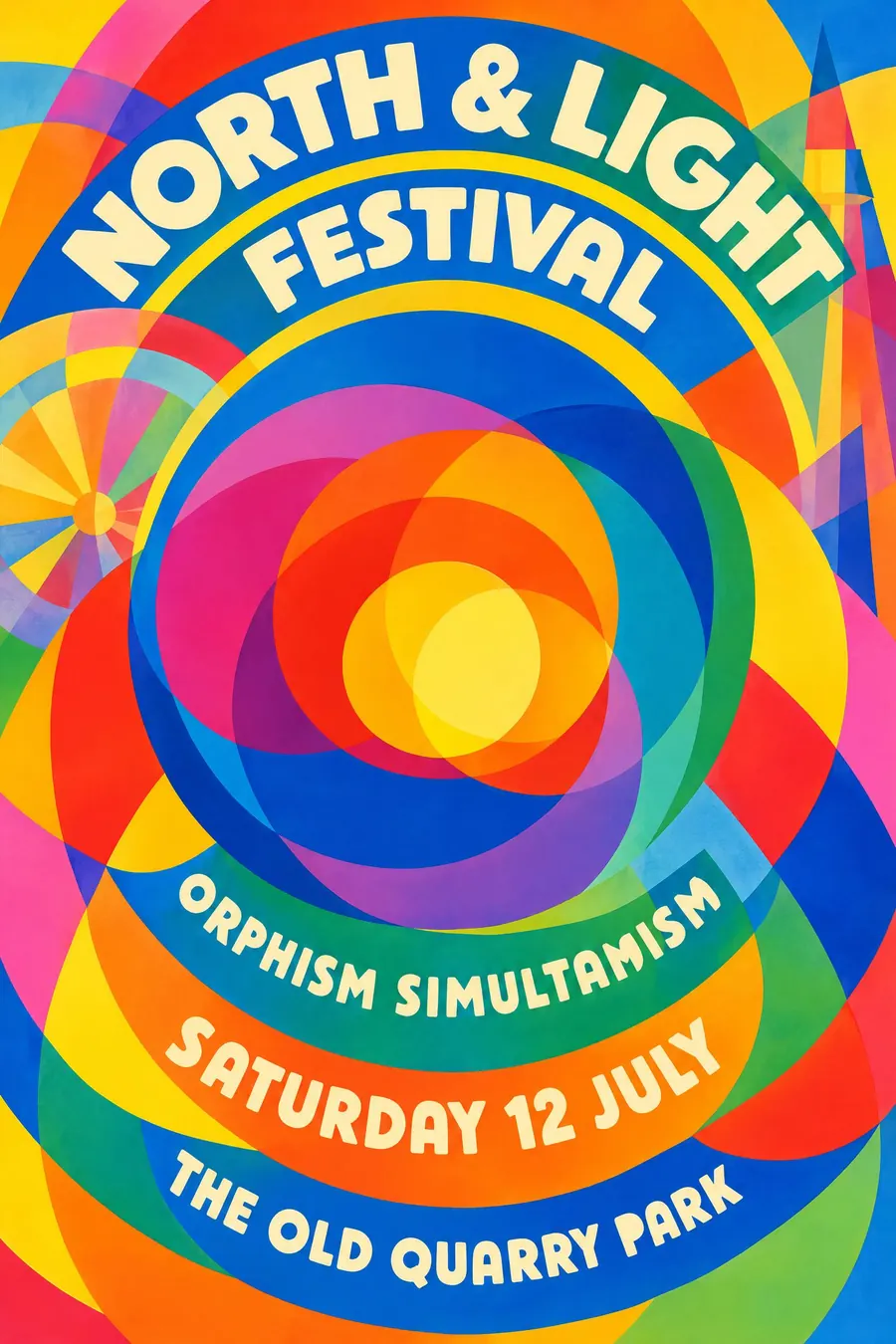
Overlapping colour discs and arcs, saturated, with the colour doing all the work.
Opens an image model with the prompt in it. The price is on the page before you sign in.
What it is for
Orphism is Cubism with the colour turned all the way up. The discs create movement and light without any illustration at all.
It is unusually joyful for an avant-garde style, which makes it one of the few abstractions that works on a summer event.
How it works
Build from concentric discs and broad arcs, overlapping so each overlap makes a new colour.
Use fully saturated contrasting pairs: orange against blue, red against green. No black anywhere, and no outline: the edge is simply where two colours meet.
Let a faint fragmented subject sit behind the discs, a wheel, a tower, an aeroplane. Lettering is rounded geometric and follows the curve of an arc.
When to use it
Use it for a summer festival, a dance event, a colour-heavy exhibition, a children's concert, a fabric or fashion event.
Leave it alone when you need a restrained or corporate tone. The saturation is relentless.
Told apart from its neighbours
Cubism fragments a subject in muted colour. Orphism keeps the fragmentation and replaces the muted palette with full saturation.
Op art uses contrast to trick the eye into seeing movement in black and white. Orphism uses colour to suggest light.
Psychedelic posters warp the type. Orphism keeps it clean.
Where it was used
Robert and Sonia Delaunay developed it from around 1912, and Robert's Simultaneous Windows and Circular Forms series are the source of the discs. Sonia carried the same colour theory into textiles, fashion and book design, including a bound poem by Blaise Cendrars two metres long.
- Robert Delaunay
- Sonia Delaunay
- Frantisek Kupka
The prompt
Replace the blanks with your own event, keep the rest. Then run it on an image model.
poster for <event>, Orphism simultanism, overlapping concentric colour discs and broad arcs filling the sheet, fully saturated contrasting colour with no black outline, colour transitions creating the sense of light and rhythm, faint fragmented shapes of a wheel or a tower behind the discs, rounded geometric lettering that follows an arc, <date, time and place> curved along the lower disc
What goes wrong
The model returns outlined circles. Say there are no black outlines and the edges are simply where two saturated colours meet.
The second failure is a pastel palette. Ask for fully saturated contrasting pairs, orange against blue and red against green.
Leave out
muted colour, black outlines, realistic subject, empty white space
Watch for
No outlines. The edges are where two colours meet, nothing more.
Questions
Print it
Pay for the one run. No subscription, and the price is on the model page before you sign in.
Next to it in between the wars