Triadic
- three point harmony
- primary triad
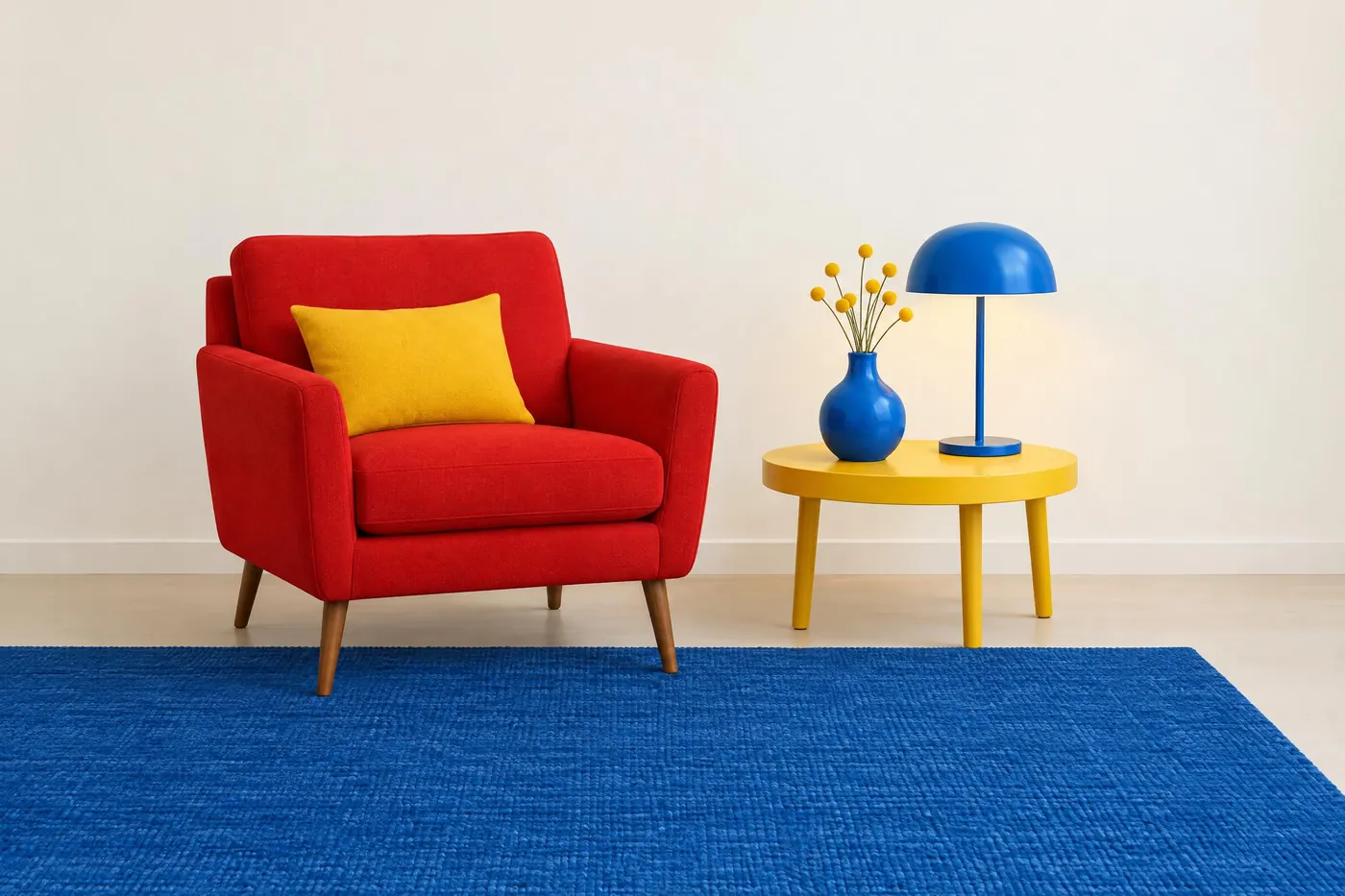
Three colours spaced evenly around the wheel, balanced and loud.
Opens an image model with the palette in the prompt. The same words work on a video model.
- #C8452F
- #E5B62E
- #2E5E94
- #F4F1E8
- #262626
What it is for
Three evenly spaced hues cover the whole wheel, so a triadic scheme feels complete in a way two colours never do. Nothing is missing from it.
It is also inherently balanced, which is why it survives on things that must not look like they have a point of view: toys, school books, public information.
How it works
Space the three evenly, a third of the wheel apart. Red, yellow and blue is the famous one; orange, green and violet is the same scheme rotated.
Choose a leader. One colour takes most of the picture, the other two appear in small deliberate amounts.
Hold the saturation flat across all three, and put them on a neutral ground. Three strong colours plus a fourth coloured background is where this scheme collapses.
When to use it
Use it for anything playful, civic or modernist: a children's event, a school, a design show, a market, a poster in the Bauhaus manner.
Leave it alone for anything sombre or premium. A triad reads as open and friendly and cannot be talked out of it.
Told apart from its neighbours
Tetradic adds a fourth colour, which doubles the richness and roughly quadruples the difficulty of keeping control.
Split-complementary also uses three hues, but two of them are neighbours. Here all three are strangers, which is why it is louder.
Where it was used
Bauhaus built its whole teaching on the primary triad, and De Stijl restricted itself to exactly those three plus black and white. A century later the same three colours mean children's publishing, which is what happens to a scheme that works.
- Bauhaus
- De Stijl
- children's publishing
The prompt
Run it as it stands, or drop the colour clause into a prompt you already have. It works in an image prompt and in a video prompt.
<subject>, triadic palette of red, yellow and blue spaced evenly on the wheel, one dominant and the other two as accents, flat even saturation, an off-white ground, no fourth hue
What goes wrong
All three arrive at the same weight and the picture reads as a toy. Say one dominates and the other two are accents.
A fourth colour appears, usually in the background. Say the ground is neutral off-white and there is no fourth hue.
Leave out
a fourth hue, equal thirds, muted mixtures
Watch for
Three strong colours at equal amounts is a toy. One has to lead.
Questions
Paint it
Pay for the one run. No subscription, and the price is on the model page before you sign in.
Next to it in relationships on the wheel