Wet plate collodion
- wet plate
- collodion process
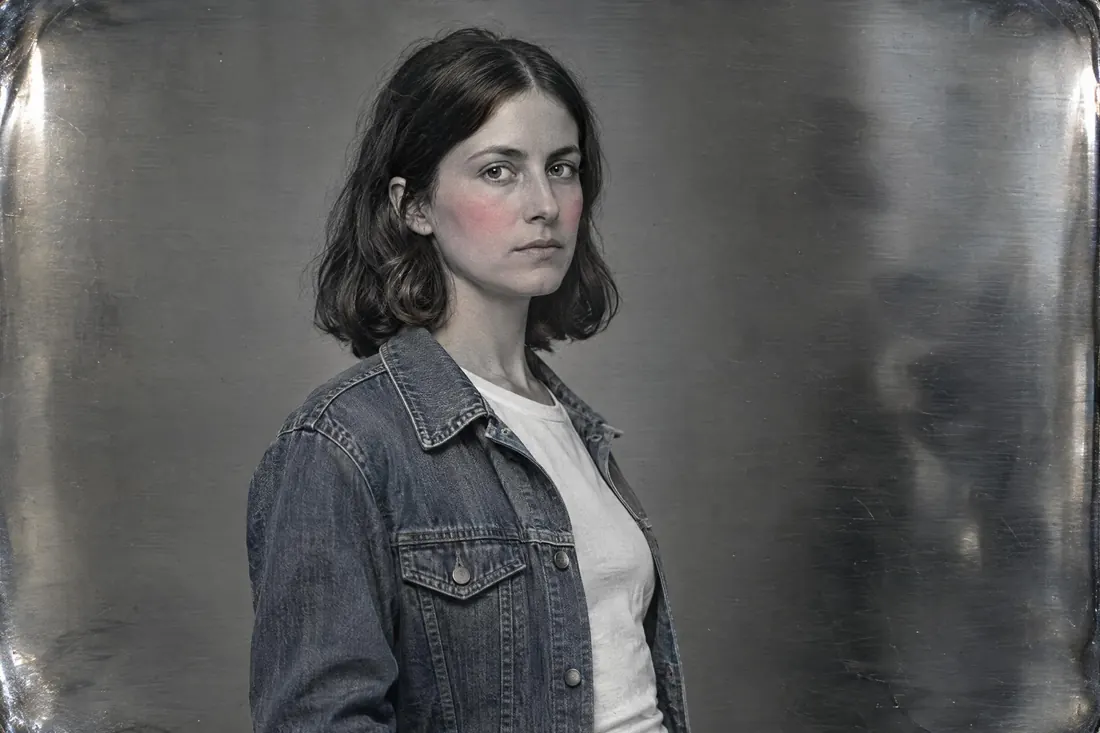
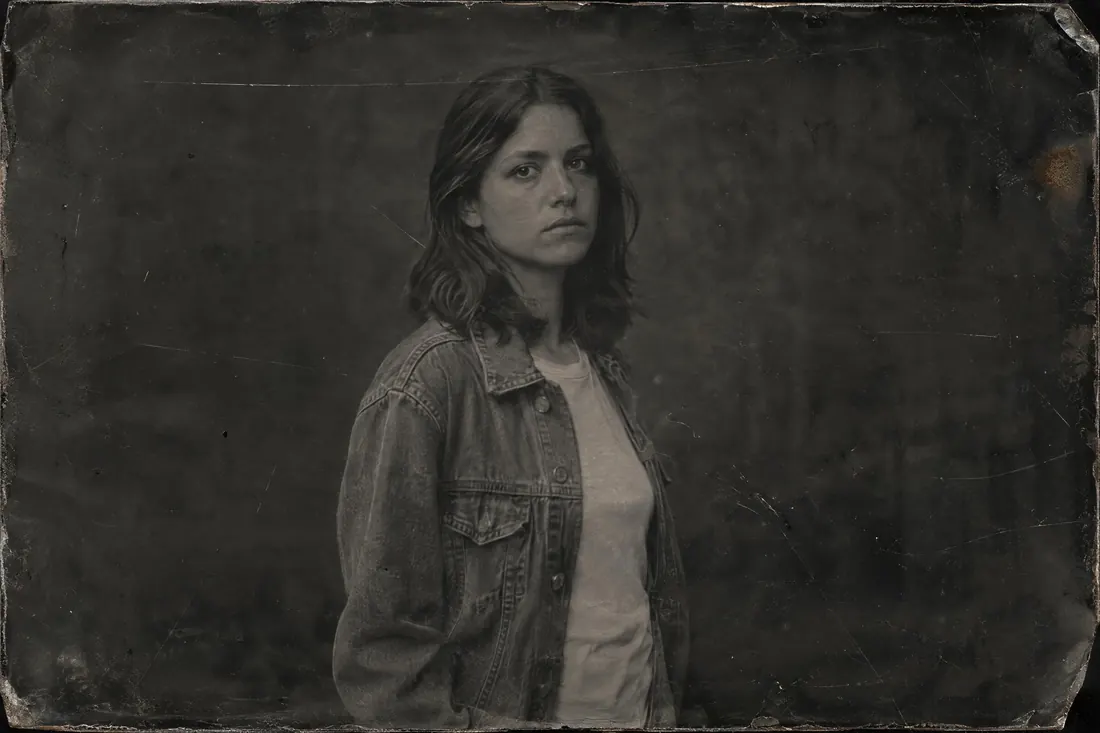
A hand poured plate that streaks at the edge, goes blind to red, and leaves the sky blank white.
Opens an image model with the prompt in it. The price is on the page before you sign in.
What it is for
A collodion plate records a different world from the one the eye sees. The emulsion answers to blue and ultraviolet light and to almost nothing else, so the tonal order of a face changes. Skin goes pale and smooth, red lips go black, freckles go black, and a pale blue eye turns almost white. That shifted order is what makes a collodion portrait read as old rather than as filtered.
The second half of the look is the hand. A person pours, drains and dips every plate, so every plate carries the record of that minute: a thin corner, a run of bare glass, a thumb mark in the emulsion. No two plates match. A clean digital imitation copies the border and misses this, which is why it reads as a frame rather than as a plate.
How it works
Say what the coating does. The maker pours collodion onto glass, tips the plate to spread it, then drains the excess off one corner. The coating thins where it drained and thickens where it pooled, so the plate edge carries pour lines, bare streaks and an uneven black border. Keep those marks at the edge, not across the middle.
Say what the plate cannot see. The emulsion is sensitive to blue and ultraviolet only. A blue sky exposes as fully as a white wall, so it records blank white with no cloud in it. Anything red records as black, which moves the lips, the freckles and a red dress down to the bottom of the grey scale.
Say that the plate is wet. The whole cycle of coat, sensitise, expose, develop and fix runs inside about ten minutes, before the collodion dries and stops working. That means a dark tent beside the camera, a plate holder that drips, and an exposure of seconds rather than a fraction of a second. A sitter holds a pose, and anything that moves smears.
When to use it
Use it for a portrait, a standing figure or a still object that can hold for several seconds. It suits a face with texture, because the blue sensitivity makes every freckle, vein and blemish read dark.
Leave it alone for a landscape that needs weather in it. The sky comes back blank, and period landscape printers had to print a second cloud negative over the top to fix that.
Told apart from its neighbours
An ambrotype and a tintype use the same chemistry on a different support and finish as positives. This entry is the negative: a thin, dense glass plate that a printer then contacts onto albumen paper.
Cinema publishes Film Grain at /techniques/cinema/ as a moving texture laid over a modern image. Collodion carries no grain at all. Its marks are pour lines, dust comets and bare glass, and they sit at the plate edge rather than across the whole frame.
Cinema also publishes Monochrome, which drops the colour and keeps the modern tonal order. Collodion changes that order. The sky and the lips move, not just the saturation.
Where it is used
Frederick Scott Archer published the process in 1851 and left it unpatented, so it spread fast and pushed the daguerreotype out of the studios within about five years. It carried the field photography of the American Civil War, made from wagons fitted out as dark tents, and it produced the negatives behind almost every carte de visite of the 1860s. Dry gelatin plates replaced it commercially around 1880, because a dry plate could be bought, carried and developed later. Portrait studios still run it today and sell the plates as objects.
- 1860s field photography wagons
- carte de visite studios
- modern collodion portrait studios
The prompt
Replace the blanks with your own subject, keep the rest. Then run it on an image model.
<subject>, wet plate collodion negative on glass, poured by hand so the coating thins and streaks toward one corner, comet shaped dust marks through the emulsion, an uneven black border with bare patches at the plate edge, sensitive to blue only so the sky records as blank white, red lips and freckles go black and pale eyes go ghostly, shallow silver grey tone, a long exposure and a still head
What goes wrong
The model returns a clean grey photograph inside a decorative torn border. Say the border is uneven and black with bare patches where the coating drained, and put the pour marks at the plate edge.
The second failure is a normal sky. Say the plate is sensitive to blue only, so the sky records as blank white with no cloud in it.
Leave out
clean straight borders, a blue sky with clouds, modern colour response, an even coating, a decorative torn frame
Watch for
The blue blindness is the look, not the pour marks. Ask for the white sky and the black lips first, then for the edge.
Questions
Shoot it
Pay for the one run. No subscription, and the price is on the model page before you sign in.