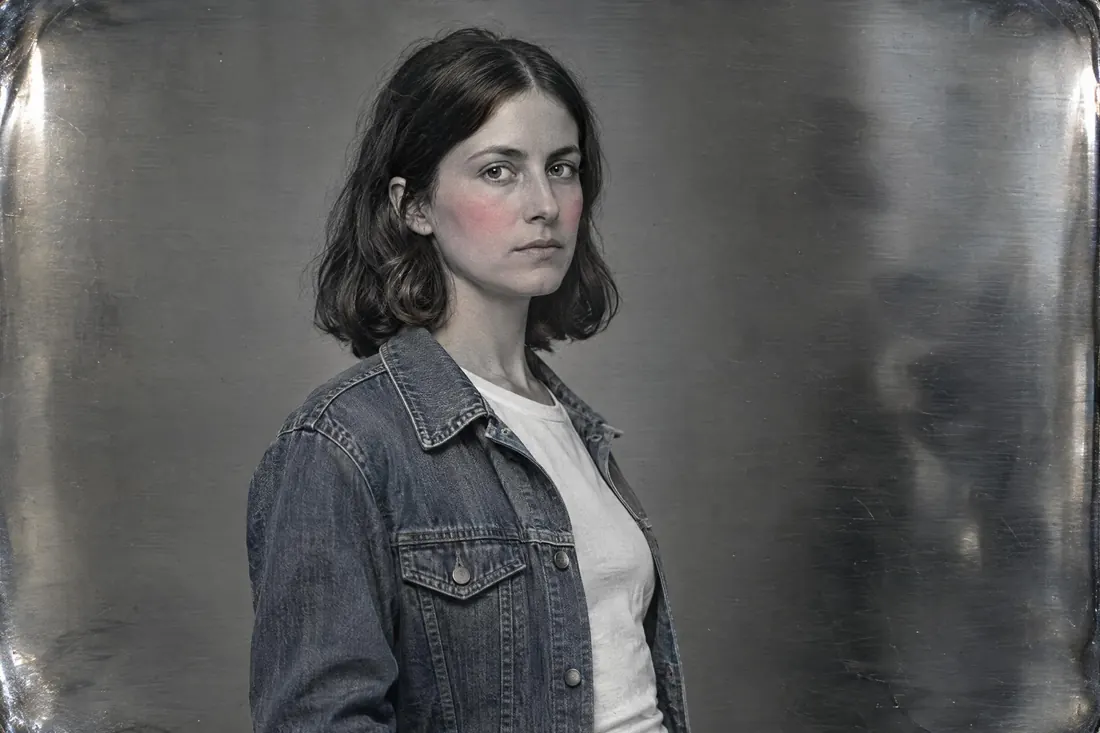
Tintype
- ferrotype
- melainotype
A collodion positive on blackened iron: dark, flat, silvery, cut to size and scratched.
Opens an image model with the prompt in it. The price is on the page before you sign in.
What it is for
A tintype is the first photograph made for people with no money. It cost a few cents, it came back in minutes, and it went home in a paper sleeve. That economy shows in the object: the metal is thin, the edges are sheared rather than cut clean, and the varnish is scratched because the thing lived in a pocket.
It is also tough. Glass breaks and paper tears, but a sheet of iron bends and comes back. That is why tintypes survive from battlefields, fairgrounds and beaches in numbers no other early process can match, and why so many of them carry a bent corner and a spot of rust.
How it works
Set the support. The plate is a thin sheet of iron japanned with black lacquer, not tin, and the collodion goes straight onto that black. There is no cover glass and no brass mat unless the customer paid for one. Say sheared edges with a burr, and say the sheet is thin enough to bend.
Set the tone. The black lacquer under the image means no light comes back from behind, so the picture is darker and flatter than an ambrotype, with a silvery sheen in the highlights and no true white anywhere. The whole scale sits in the lower half, which is the plainest tell of the process.
Say the image is laterally reversed. Like the daguerreotype, a tintype has no negative stage, so the left and right of the subject swap. Uniform buttons on the wrong side and reversed lettering on a shop sign are the details that sell it. Add the wear: fine scratches through the varnish, a spot of rust at the edge, a bent corner.
When to use it
Use it for a working person, a soldier, a fairground portrait or anything that should look cheap, fast and hard wearing. It also suits a stiff standing pose against a painted backdrop, which is what a travelling photographer carried.
Leave it alone when the picture needs brightness or delicacy. There is no clean white in a tintype, and a light dress or a pale sky comes back grey.
Told apart from its neighbours
An ambrotype is the same collodion positive on glass with a black backing behind it. It is lighter, warmer and softer, and it lives under cover glass in a case. A tintype is the metal version: darker, flatter and bare.
A daguerreotype is a mirror with far finer detail. Both are laterally reversed, which is why they get mixed up in a caption, but nothing else about them matches.
Cinema publishes Vintage at /techniques/cinema/ as a grade where the colour behaves like film stock that has aged. A tintype has no colour to age. Its wear is physical: scratches through varnish, sheared metal and rust.
Where it is used
Hamilton Smith patented the process in the United States in 1856, and it sold for the next fifty years because it was cheap and quick. A stall photographer could take the plate, develop it and hand it over in a few minutes, which made it the standard portrait at fairs, on piers and outside army camps. Gem tintypes of about 25 millimetres wide arrived in 1863, cut several to a plate and sold to fit a locket or an album slot. Seaside stalls in Britain and the United States were still making them in the 1930s.
- fairground and beach photography stalls
- American Civil War soldier portraits
- gem tintype lockets
The prompt
Replace the blanks with your own subject, keep the rest. Then run it on an image model.
<subject>, tintype from 1875, collodion positive on a thin sheet of blackened iron, dark and flat with a silvery sheen in the highlights, laterally reversed, shallow contrast with no true white, sheared edges with a burr and one bent corner, fine scratches through the varnish and a spot of rust, held in a plain paper sleeve
What goes wrong
The model returns a bright, clean black and white photograph with a white border. Say the support is blackened iron, the tone is dark and flat with no true white, and the edges are sheared with a burr.
The second failure is a picture that reads the right way round. Say the image is laterally reversed, and name a detail that proves it, such as buttons or lettering on the wrong side.
Leave out
glass, a mirror surface, bright whites, clean cut edges, a heavy hinged case, a smile
Watch for
It is iron, not tin. Ask for a blackened iron sheet with sheared edges, and say the picture is laterally reversed.
Questions
Shoot it
Pay for the one run. No subscription, and the price is on the model page before you sign in.
Next to it in silver on metal and glass