Worm's-Eye View
The camera sits on the ground and looks steeply upward.
Opens a video model with the prompt in it. The price is on the page before you sign in.
What it is for
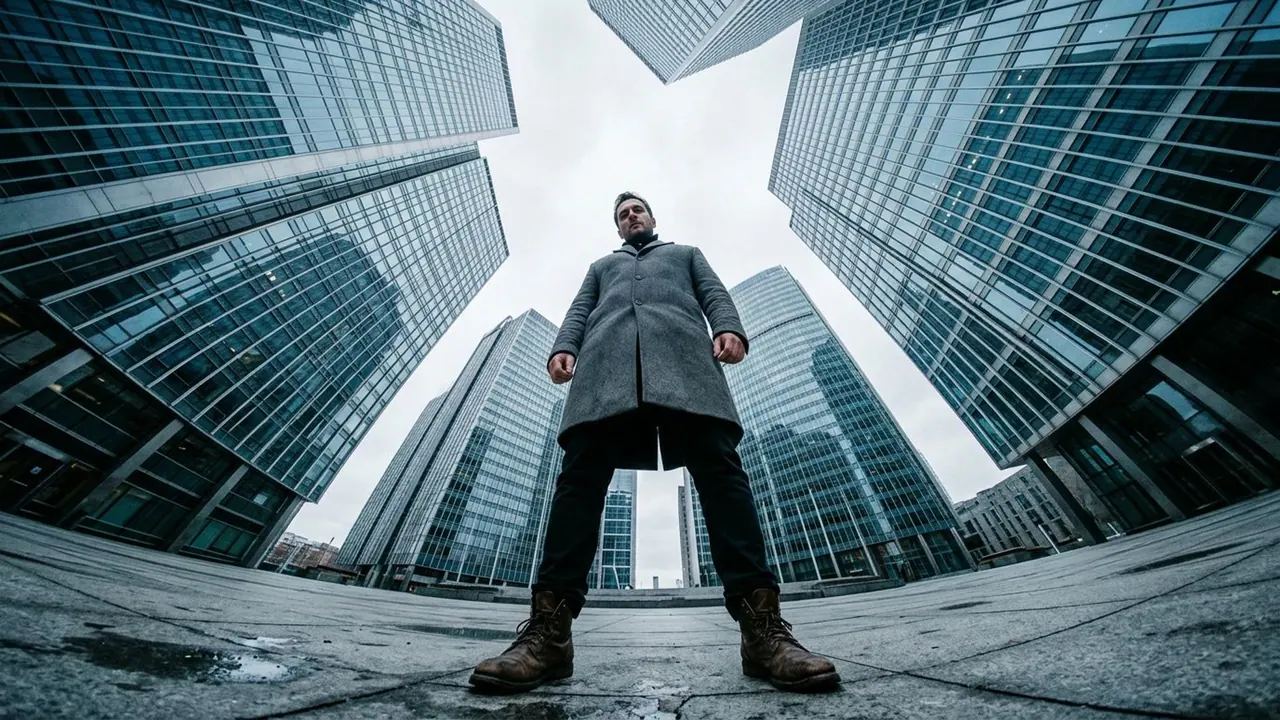
The camera lies on the ground and looks steeply up, so everything above leans inward and the subject becomes a tower. It is the most extreme reading of size the angle can give.
The distortion is the content. Straight lines stop being straight, and a room seen this way looks like it is closing over the top of the frame.
How it works
The lens sits on the surface and tilts sharply upward, often past forty five degrees. Verticals converge toward the top of the frame, which is the signature of the shot.
A wide lens makes it stronger. At 18mm or 24mm the convergence is severe and whatever is closest to the camera swells, so a foot or a hand near the lens reads as enormous.
Ceiling or sky fills most of the picture. That is the cost of the angle: the background is gone and whatever is above the subject becomes the set.
When to use it
Use it for domination, for a building seen from its base, and for the moment a character on the floor looks up at somebody who is not.
Do not reach for it when a mild upward look would do. Used more than once or twice the distortion stops meaning anything and starts reading as a lens choice.
Told apart from its neighbours
A low angle can be a foot below the eyes with the subject still in proportion. A worm's eye view is on the ground with the verticals visibly leaning.
Ask whether the lines bend. If the doorframes and the walls converge toward the top of the frame, you have a worm's eye view. If they stay parallel, it is a low angle.
The prompt
Replace the blanks, keep the rest. Then run it on a video model.
worm's eye view of <subject>, camera on the ground looking steeply up, extreme vertical distortion, subject towering
What goes wrong
Models deliver a moderate low angle and stop there. Ask for the distortion by name: extreme vertical convergence, camera on the ground, subject towering.
The second failure is a clean sky with nothing to converge. Give the shot verticals to bend, such as walls, columns or a doorframe.
Leave out
eye level, high angle
Watch for
It is more extreme than a low angle. Ask for the distortion by name.
Questions
Shoot it
Pay for the one run. No subscription, and the price is on the model page before you sign in.
Next to it in the height ladder