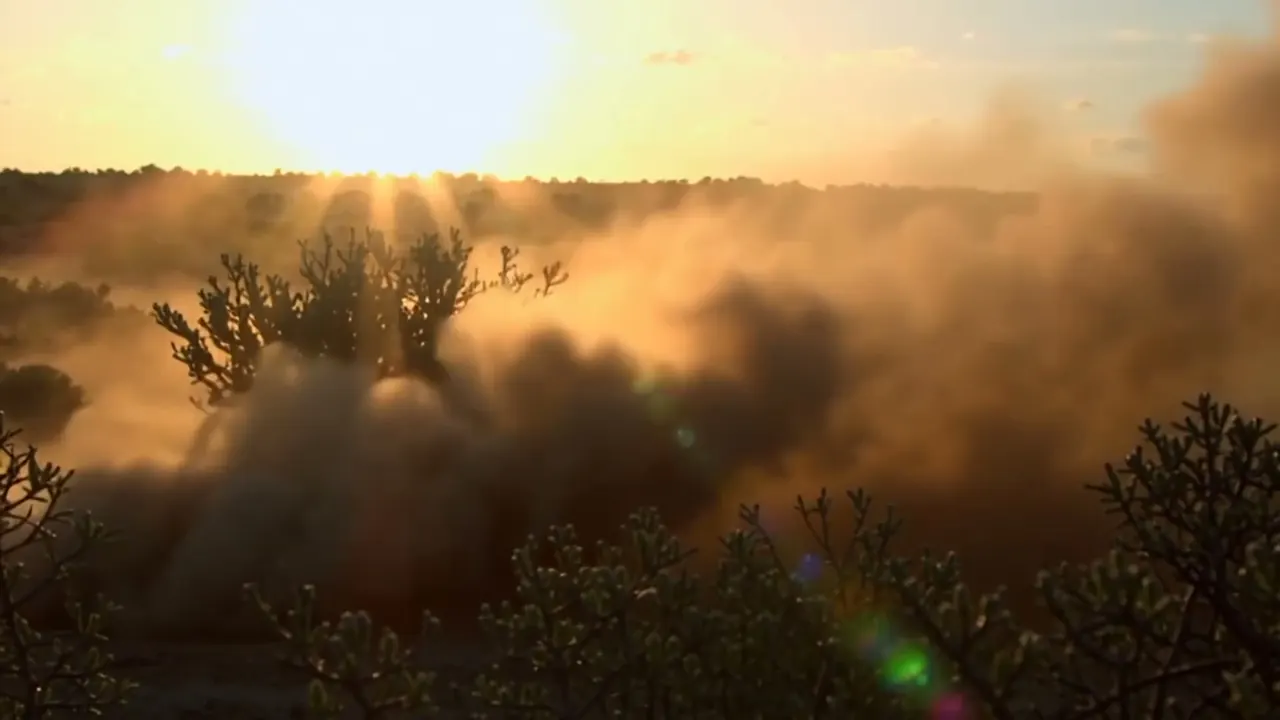
Bullet Time
- Time-slice orbit
- The Matrix effect
Time nearly stops while the camera keeps travelling around the subject.
Opens a video model with the prompt in it. The price is on the page before you sign in.
What it is for
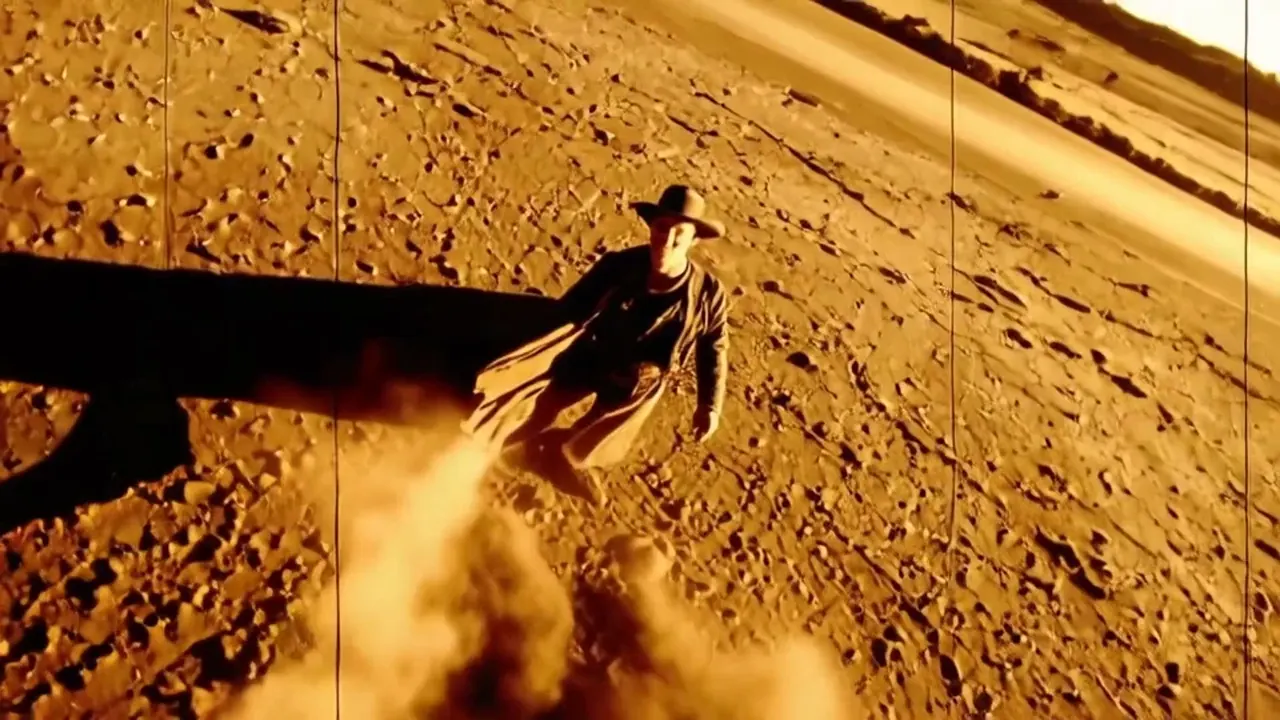
The action nearly stops and the camera keeps travelling, so the audience gets to walk around a moment that lasted a fraction of a second. It turns an instant into a place.
It reads as a break in the rules of the scene. Time belongs to the camera rather than to the world, which is why it suits stories where a character has stepped outside ordinary limits.
How it works
The original method is a ring of still cameras around the subject, fired in sequence a few milliseconds apart. Playing those images back in order gives a camera move through a moment that never moved. The Matrix (1999) used rigs of over a hundred cameras this way.
The path is the shot. A straight track past the subject, an arc around the head, a full orbit: each one says something different, and the speed of the travel is the only speed left in the frame.
Frames between the camera positions are usually filled in afterwards, which is why the move looks smoother than the number of cameras should allow.
When to use it
Use it once, on the moment the story has been building to. It is expensive attention and it does not survive repetition.
Skip it when the action is already slow. Bullet time needs something fast to freeze, or there is nothing for the stillness to contrast against.
Told apart from its neighbours
Slow motion slows the action and leaves the camera behaving normally. Bullet time nearly stops the action and gives all the remaining movement to the camera. If the camera is still, it is slow motion.
A freeze frame stops everything, including the camera. Bullet time stops everything except the camera. That one difference is the whole technique.
On film
The Matrix (1999) is the reference, and the rooftop dodge is the shot everyone means by the name. Neo bends backward, the bullets hang in the air, and the camera sweeps around him through a moment that has stopped.
- The Matrix (1999)
The prompt
Replace the blanks, keep the rest. Then run it on a video model.
bullet time around <subject>, action almost frozen mid-motion, camera orbiting at full speed through the frozen moment
What goes wrong
The camera freezes along with the subject and you get a still image. Say the camera keeps moving at full speed through the frozen moment, and name the path it takes.
The other failure is ordinary slow motion. Ask for the action to be almost stopped rather than slowed, so the contrast with the moving camera is obvious.
Leave out
frozen camera, normal speed
Watch for
The camera must keep moving. A still camera on frozen action is just a freeze frame.
Questions
Shoot it
Pay for the one run. No subscription, and the price is on the model page before you sign in.
Next to it in faster or slower