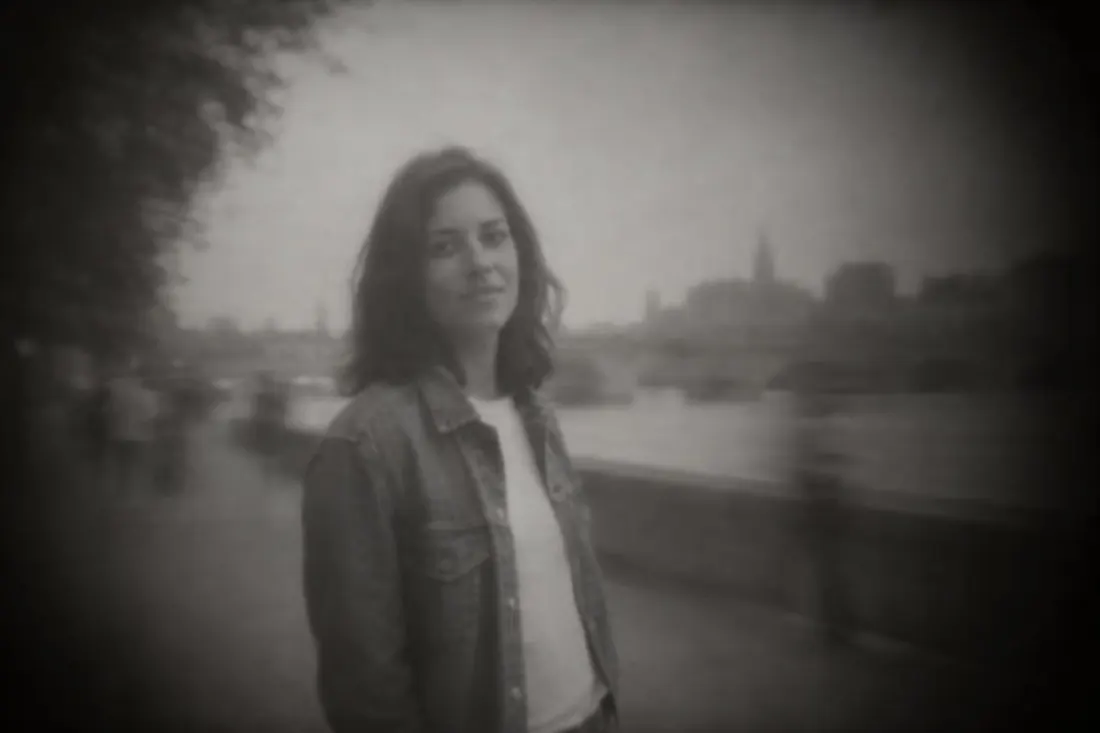
Half frame
- 18x24
- single frame
- 72 on a roll
Half of a 35mm frame: an 18mm by 24mm upright picture, 72 to a roll, with the grain twice the size.
Opens an image model with the prompt in it. The price is on the page before you sign in.
What it is for
A half frame camera splits one 35mm frame in two. Each picture is 18mm by 24mm, and a 36 exposure roll gives 72 pictures. The frame is upright when the camera is held level, because the long side of the film now runs across two pictures instead of one.
Everything else follows from the smaller frame. The negative has half the area, so it is enlarged twice as much for the same print, and the grain looks about twice the size of normal 35mm grain. The depth of field at the same framing is deeper, because the normal lens on this format is about 30mm rather than 50mm.
How it works
Name the format and the frame: half frame 35mm, 18mm by 24mm, upright. Say portrait orientation in plain words, or the model will return a landscape picture out of habit.
Ask for the grain to be large. It is the honest result of enlarging a small negative twice as far, and it is the thing that separates a half frame picture from a normal 35mm one at a glance.
Ask for the diptych if you want the signature of the format. Two half frames sit side by side on one strip, separated by the rebate and the sprocket holes, and a pair printed together is what the format is known for. Name both pictures, because the pair only works when the two have a relation.
When to use it
Use it for a pair: a before and an after, a face and a hand, a wide view and the detail inside it. The format puts two pictures in one frame of film and invites the reader to connect them.
Leave it alone when a single picture has to carry the whole idea, or when the subject needs fine detail. Half the area is half the detail, and the grain is the price.
Told apart from its neighbours
Cinema publishes Ratio Switch at /techniques/cinema/ for a change of aspect ratio, and Double Exposure for two pictures in one frame. The half frame diptych is neither of those. It is two separate exposures on two separate frames, printed side by side because the film puts them there, with the sprocket holes still between them.
Cinema also publishes Film Grain at /techniques/cinema/ on its own. This entry sets the size of the grain rather than its presence, because the enlargement is doubled and the grain grows with it.
35mm format is the parent: the same film, the same cassette, twice the frame area, and a landscape shape by default. Phone camera is the modern equivalent for the upright frame, and it removes the grain that this format doubles.
Where it is used
Olympus shipped the Pen in 1959 and the Pen F single lens reflex in 1963, both designed by Yoshihisa Maitani, and the small frame let the body be small enough for a pocket. Canon answered with the Demi in 1963. The format faded in the 1970s when cheap full frame 35mm compacts arrived, and it came back when film prices rose again. Kodak released the Ektar H35 in 2022, and Pentax shipped the Pentax 17 in June 2024, the first new half frame camera from a major maker in decades.
- Olympus Pen cameras
- the Canon Demi
- contact sheets with paired frames
The prompt
Replace the blanks with your own subject, keep the rest. Then run it on an image model.
<subject>, half frame 35mm, 18mm by 24mm upright frame in a 3:4 portrait shape, grain twice the apparent size of normal 35mm grain, two frames side by side on one strip with the film rebate and the sprocket holes between them, simple fixed lens with deep depth of field
What goes wrong
The picture comes back landscape. Say upright 18mm by 24mm frame and portrait orientation, and put the ban on landscape in the same line.
Only one frame appears when you asked for the pair. Say two half frames side by side on one strip, with the film rebate and the sprocket holes visible between them.
Leave out
landscape orientation, a single isolated frame, fine grain, medium format smoothness
Watch for
The camera is held normally and the picture comes out upright. To get a landscape picture you turn the camera on its side, which is the opposite of every other camera.
Questions
Shoot it
Pay for the one run. No subscription, and the price is on the model page before you sign in.