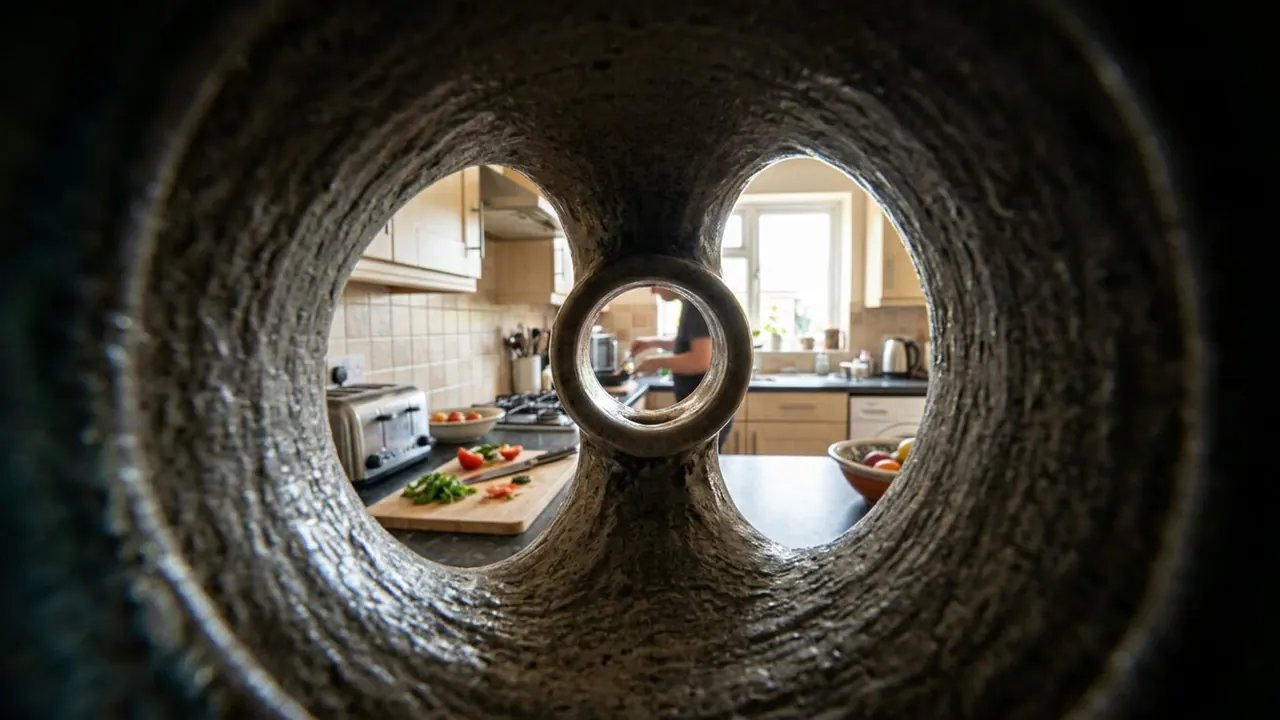
Split Diopter
- Split-field diopter
Half the lens focuses near and half far, so both planes are sharp at once.
Opens a video model with the prompt in it. The price is on the page before you sign in.

What it is for
A split diopter holds a near plane and a far plane sharp at once, with nothing sharp in between. Two things that could never both be in focus arrive both in focus, in one frame, with no cut.
It puts two ideas in the same picture and refuses to rank them. A face in the foreground and a door across the room both demand attention, and the audience has to hold both.
How it works
The device is half a close-up lens fitted over one side of the main lens. That half shortens the focus distance for its side of the frame, so near and far focus at the same time.
The join between the two halves is visible as a soft vertical or diagonal seam. Filmmakers hide it along an edge already in the frame, such as a door jamb, a wall or a pillar.
It needs a real gap between the planes. A subject at half a metre and another at ten metres works. Two people three metres apart do not need it at all.
When to use it
Use it when two things have to be watched at once: somebody in the foreground and a threat behind them, a hand on a table and a face across the room.
Skip it when one thing should win. A rack focus moves the attention from one plane to the other and tells the audience when to move.
Told apart from its neighbours
Deep focus holds everything sharp, front to back, usually by stopping the lens down and lighting hard. The whole frame is available.
A split diopter holds only two planes and leaves a soft band between them. Look at the middle distance. If it is soft while near and far are sharp, it is a diopter.
On film
Brian De Palma built much of his visual grammar on this device, and Blow Out (1981) uses it to keep a foreground face and a distant action equally sharp. Jaws (1975) uses one on the beach so a conversation in the foreground and the water behind it both stay readable at the same time.
- Blow Out (1981)
- Jaws (1975)
The prompt
Replace the blanks, keep the rest. Then run it on a video model.
split diopter on <subject> near and <subject B> far, both planes sharp at the same time, visible soft seam between them
What goes wrong
The model deepens the focus across the whole frame, which is deep focus and a different shot. Ask for the soft seam and say the middle distance stays out of focus.
The other failure is two subjects at similar distances, which needs no diopter at all. Put a real gap between them and say how far apart they are.
Leave out
shallow focus, rack focus
Watch for
The seam is part of the look. Ask for it, or the model just deepens the focus.
Questions
Shoot it
Pay for the one run. No subscription, and the price is on the model page before you sign in.