German Expressionist Film Poster
- Caligari style
- Weimar film poster
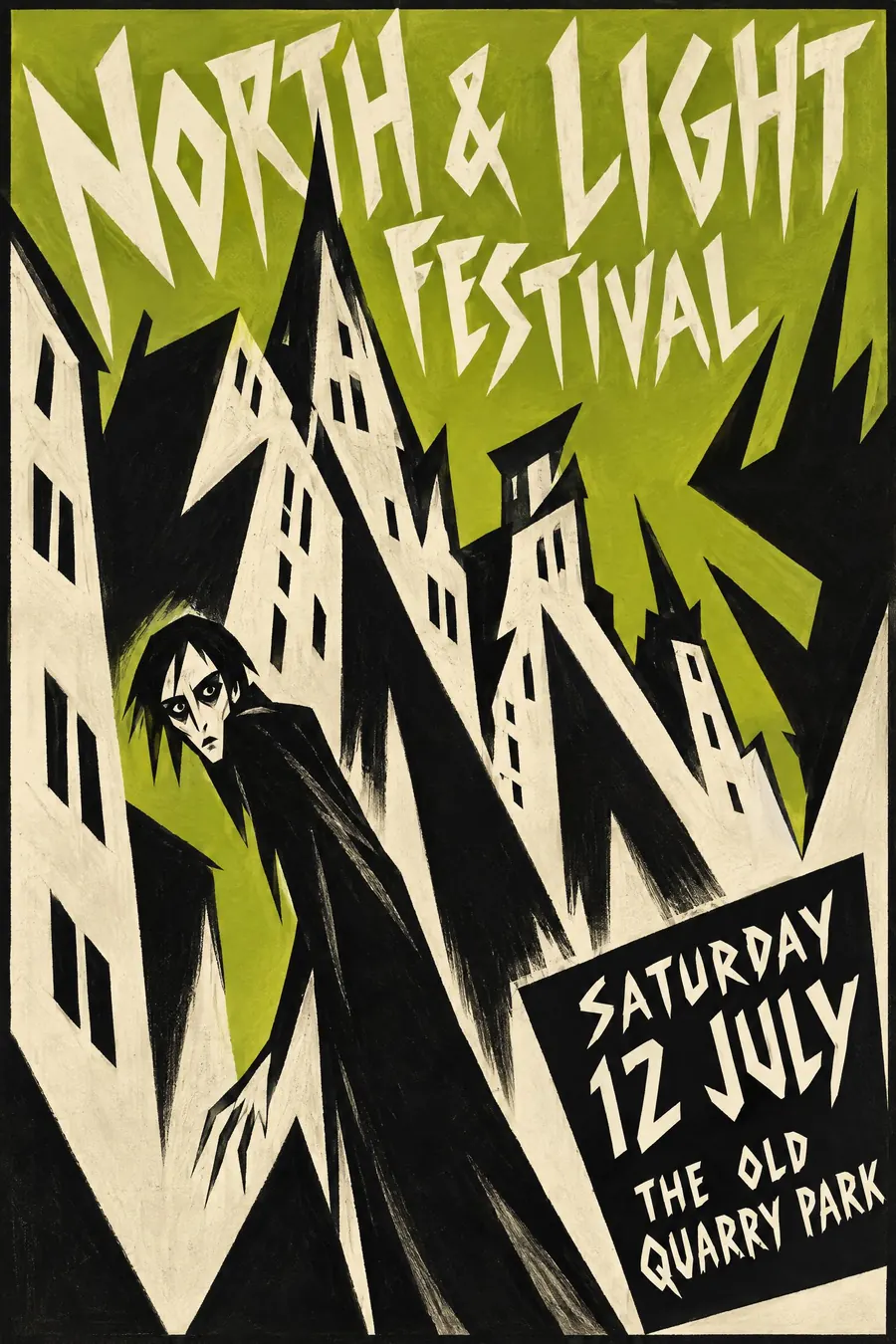
Buildings that lean, shadows painted onto the walls, and a figure stretched out of shape.
Opens an image model with the prompt in it. The price is on the page before you sign in.
What it is for
Expressionist film design put the character's state of mind into the set. Nothing is level because nothing in the story is level, and the poster inherits that.
It is also the most efficient horror shorthand there is. One leaning building and a stretched shadow does what a whole painted monster cannot.
How it works
Remove every right angle. Buildings lean, windows are trapezoids, floors tilt and streets narrow the wrong way.
Paint the shadows onto the surfaces as hard black wedges, pointing wherever the composition needs them rather than where a light would put them.
One elongated figure with a white face and dark-rimmed eyes. Flat poster paint in black, white and one sickly colour such as bile green or jaundiced yellow. Letter the title by hand, angular and leaning with the buildings.
When to use it
Use it for a horror season, a Halloween event, a silent film night, a theatre production, a ghost walk, an experimental gig.
Leave it alone for anything reassuring. The style exists to make people uneasy.
Told apart from its neighbours
Expressionist woodcut is carved and crude, with gouged white marks. This is painted and flat.
Film noir keeps the architecture honest and uses real hard light. Here the shadow is painted on the wall.
Vorticism uses hard planes with no subject. This always has a figure and a street.
- Expressionist Woodcut
- Vorticism
- Film noir imagery
Where it was used
The Cabinet of Dr Caligari in 1920 painted its shadows straight onto the flats because electricity was rationed, and that accident became the style. Nosferatu followed in 1922 and Metropolis in 1927, and the posters for all three did the same thing on paper.
- The Cabinet of Dr Caligari
- Nosferatu
- Metropolis
The prompt
Replace the blanks with your own event, keep the rest. Then run it on an image model.
poster for <event>, German Expressionist film poster 1920s, architecture leaning at impossible angles with no right angles anywhere, shadows painted directly onto the walls in hard black wedges, one elongated distorted figure with a white face and dark eyes, jagged spiky forms, flat poster paint in black white and one sickly colour, hand-drawn angular display lettering that leans with the buildings, <date, time and place> in a tilted black panel
What goes wrong
The model returns a dark moody illustration. Ask for architecture leaning at impossible angles with no right angles anywhere.
The second failure is realistic cast shadow. Say the shadows are painted directly onto the walls as hard black wedges.
Leave out
right angles, natural light, realistic proportion, symmetry, soft shadow
Watch for
The shadows are painted on, not cast. That is what makes it Expressionist rather than just dark.
Questions
Print it
Pay for the one run. No subscription, and the price is on the model page before you sign in.
Next to it in films, and how different countries sold them