Cyanotype
- blueprint
- sun print
- Prussian blue print
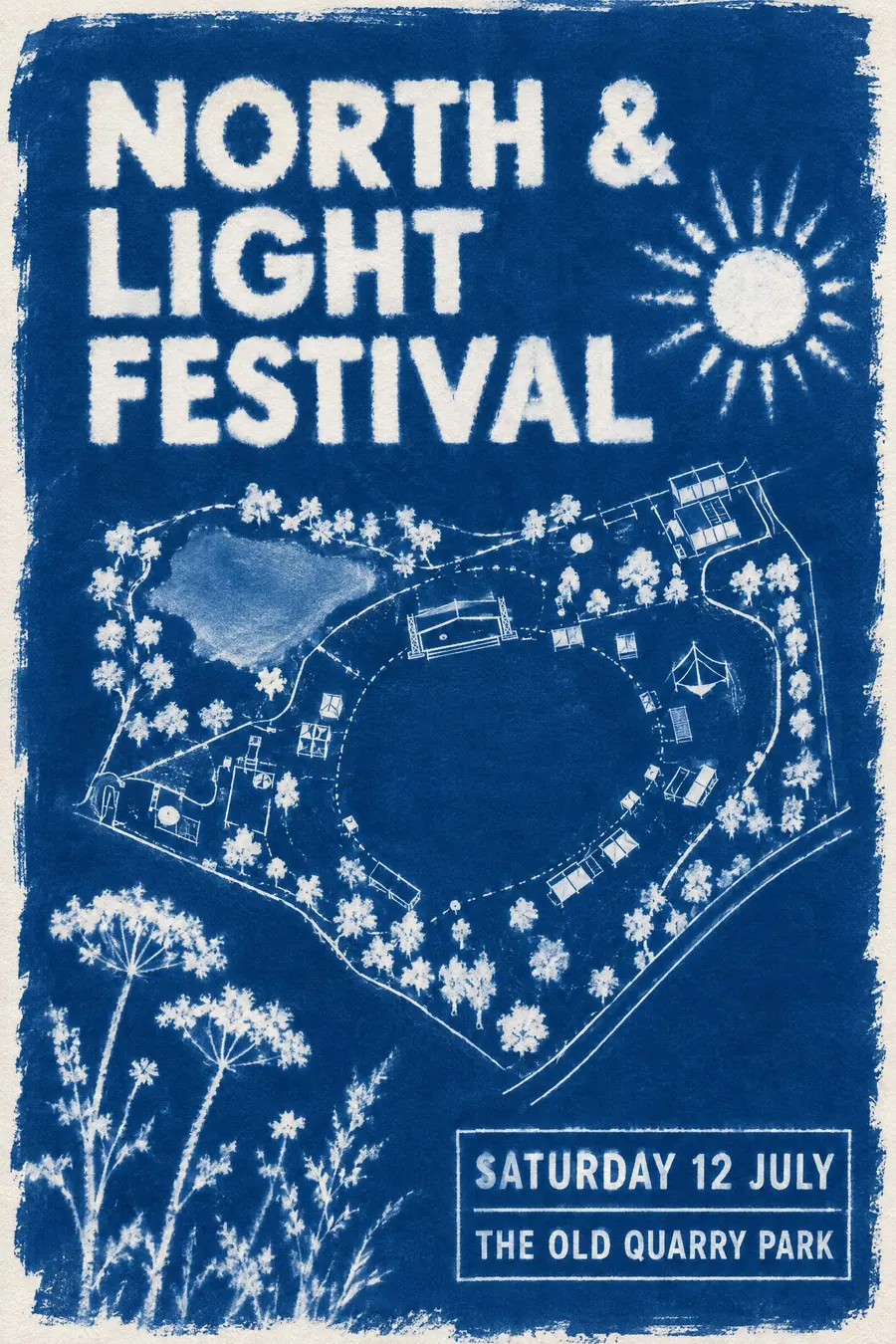
White lines on deep Prussian blue, with brush marks at the edge of the coating.
Opens an image model with the prompt in it. The price is on the page before you sign in.
What it is for
Cyanotype is the oldest photographic process still in common use, and the blue is unmistakable. One colour does all the work.
The hand-coated edge is what makes it feel made rather than designed. A brushed border around a technical drawing is an odd, good combination.
How it works
Two tones only: deep Prussian blue and the white of the paper. No greys, because the process is a contact print.
Coat by hand: the blue area has uneven brushed edges with bare paper outside it, rather than a clean rectangle.
Objects laid on the paper leave soft, slightly blurred white silhouettes. A white line technical drawing plays to the blueprint association. Use textured watercolour paper and plain white stencil capitals.
When to use it
Use it for a botanical walk, an architecture open day, a science festival, a photography workshop, a coastal or maritime event, a garden opening.
Leave it alone when the event is warm or festive. Everything comes out cold and technical.
Told apart from its neighbours
Botanical scientific illustration is drawn in ink and usually monochrome plus one accent. Cyanotype is photographic and always blue.
Monochrome plus a single accent is a typographic choice. Cyanotype is a physical process with its own texture.
Wayfinding style shares the technical air but is flat, clean and multi-coloured.
- Botanical Scientific Illustration
- Monochrome + Single Accent
- Wayfinding
Where it was used
John Herschel invented the process in 1842 and Anna Atkins used it the next year for Photographs of British Algae, the first book illustrated photographically. Architects used the same chemistry for a century, which is why plans are still called blueprints.
- Anna Atkins
- architectural blueprints
- Victorian botany
The prompt
Replace the blanks with your own event, keep the rest. Then run it on an image model.
poster for <event>, cyanotype sun print, pure white forms on deep Prussian blue, the blue coated by hand so the edges are uneven with visible brush strokes and bare paper outside them, soft slightly blurred contact-print edges as if objects were laid on the paper, a technical drawing of the venue in white line, textured watercolour paper, plain white stencil capitals, <date, time and place> in a white ruled title block in the corner
What goes wrong
The model returns a blue-tinted photograph. Say two tones only, deep Prussian blue and paper white, with no grey.
The second failure is a clean rectangular border. Ask for hand-coated edges with visible brush strokes and bare paper outside them.
Leave out
other colours, hard vector edges, photographic grey tone, clean rectangular borders
Watch for
Two tones only: Prussian blue and paper white. Any grey means the process is wrong.
Questions
Print it
Pay for the one run. No subscription, and the price is on the model page before you sign in.