Etching and Engraving
- copperplate engraving
- line engraving
- banknote style
Tone built entirely from fine parallel lines, the way a banknote is drawn.
Opens an image model with the prompt in it. The price is on the page before you sign in.
What it is for
Engraving reads as authority. Money, certificates and legal documents all use it, so a poster in this style borrows two hundred years of officialdom.
It is also extremely detailed without being busy, because the detail is all in one direction and one colour.
How it works
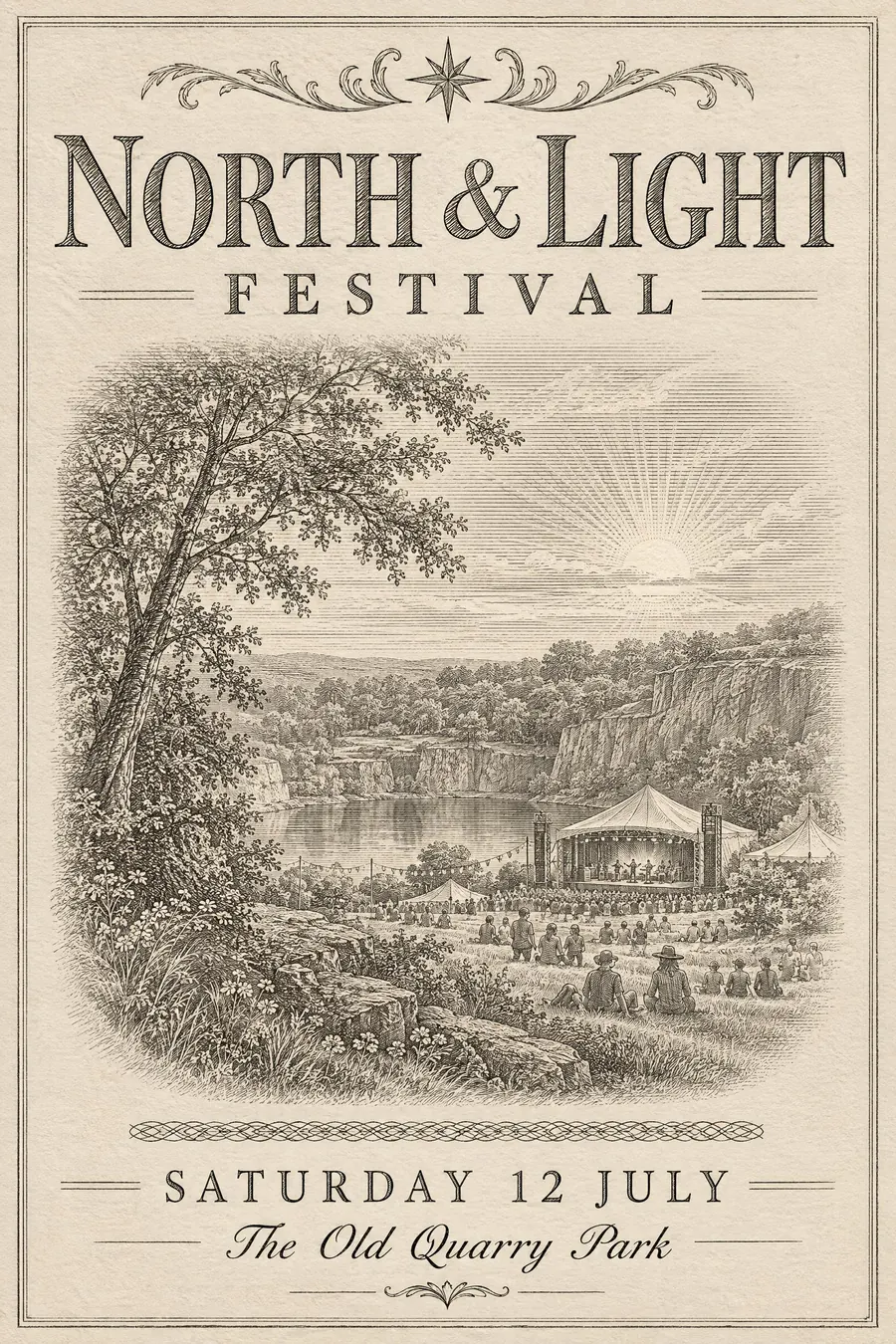
Build every tone from parallel hatching. Lines get closer for shadow, further apart for light, and cross-hatch for the darkest areas. Nothing is filled solid.
Let the lines swell and taper as the burin would, and fade the vignette out at its edges rather than cropping it into a box.
One black ink on warm cream laid paper, with a visible plate mark around the image. Type is engraved copperplate script and small roman capitals, with a guilloche rule for decoration.
When to use it
Use it for a whisky or wine tasting, a museum, a lecture, a historical society, a members club, a formal dinner, a certificate-adjacent event.
Leave it alone for anything young or casual. The style is formal to the point of stiffness.
Told apart from its neighbours
Botanical illustration uses the same line technique but for a specimen, laid out as a diagram with labels.
Woodcut is the opposite: solid black areas with white gouged out, and no fine hatching.
Penny dreadful covers are cruder wood engravings, printed badly, with a melodramatic scene.
Where it was used
Durer's engravings from around 1500 set the standard for line. The technique survives on banknotes and share certificates precisely because it is hard to copy, and whisky labels have been borrowing that authority for a century.
- banknotes
- Albrecht Durer
- nineteenth century share certificates
The prompt
Replace the blanks with your own event, keep the rest. Then run it on an image model.
poster for <event>, copperplate line engraving, all tone built from fine parallel hatching and cross-hatching with no solid black areas, lines swelling and tapering to describe form, a detailed central vignette fading out at the edges, single black ink on warm cream laid paper with a visible plate mark, engraved copperplate script and small roman capitals, decorative guilloche rule, <date, time and place> in engraved italic beneath the vignette
What goes wrong
The model returns a drawing with solid black shadows. Say every tone is fine parallel hatching and cross-hatching, with no solid fills anywhere.
The second failure is uniform digital line weight. Ask for lines that swell and taper along their length.
Leave out
solid fills, halftone dots, colour, soft edges, digital line weights
Watch for
No solid black. Every dark area is made of lines close together.
Questions
Print it
Pay for the one run. No subscription, and the price is on the model page before you sign in.