Botanical Scientific Illustration
- plate illustration
- specimen drawing
- natural history plate
A specimen drawn precisely, labelled, and laid out like a page from a reference book.
Opens an image model with the prompt in it. The price is on the page before you sign in.
What it is for
A plate layout makes a poster read as knowledge rather than advertising, and people treat knowledge more politely than they treat a sales pitch.
It also solves a layout problem: labelled studies give you somewhere structured to put five different pieces of information.
How it works
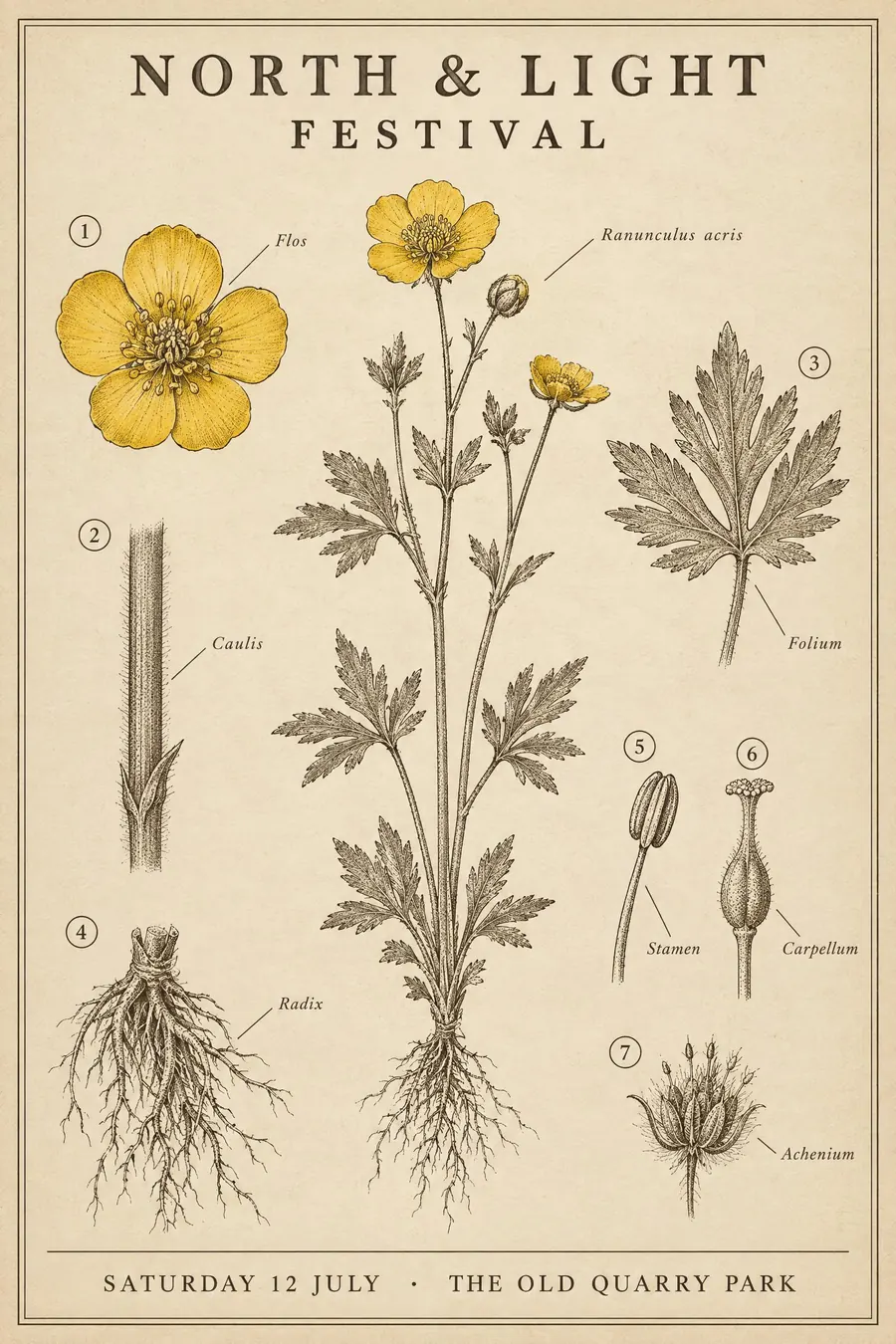
Draw one specimen precisely in ink line, with stipple rather than wash for shading.
Break it into separate studies on the same page: root, stem, leaf, flower in section, seed. Number the details in small circles.
Run thin leader lines to italic labels. Keep it monochrome sepia with one restrained highlight colour, on aged plate paper with a printed frame and a caption line beneath.
When to use it
Use it for a plant sale, a garden opening, a foraging walk, a science festival, a museum event, a brewery or distillery using botanicals.
Leave it alone for anything loud. The style is quiet and expects to be read close up.
Told apart from its neighbours
Engraving is the same line technique used for a vignette rather than a labelled specimen.
Cyanotype records a real specimen photographically in blue, with no drawing and no labels.
Wayfinding also labels things, but with icons and arrows for a physical place.
- Etching / Engraving
- Cyanotype
- Wayfinding
Where it was used
Curtis's Botanical Magazine has been printing plates since 1787 and still does. Ernst Haeckel's Art Forms in Nature of 1904 pushed the same layout into something closer to design, and Kew's plate books are the reference most illustrators still copy.
- Curtis's Botanical Magazine
- Ernst Haeckel
- Kew plate books
The prompt
Replace the blanks with your own event, keep the rest. Then run it on an image model.
poster for <event>, botanical scientific illustration plate, one specimen drawn in precise ink line with fine stipple shading, root stem leaf and flower arranged as separate labelled studies on the page, small numbered details in circles, thin leader lines to italic Latin labels, monochrome sepia line with one restrained highlight colour, aged plate paper with a printed frame, engraved small capitals for the title, <date, time and place> in the caption line beneath the plate
What goes wrong
The model returns a pretty watercolour of a plant. Ask for precise ink line with stipple shading, separate labelled studies and numbered details in circles.
The second failure is no labels. Say there are thin leader lines running to italic Latin labels and a caption line beneath the plate.
Leave out
photographic rendering, bright colour, decorative backgrounds, loose sketching
Watch for
The labels carry it. Without leader lines and Latin names it is just a drawing of a plant.
Questions
Print it
Pay for the one run. No subscription, and the price is on the model page before you sign in.