Rosemaling
- Scandinavian folk painting
- Norwegian rosepainting
- kurbits
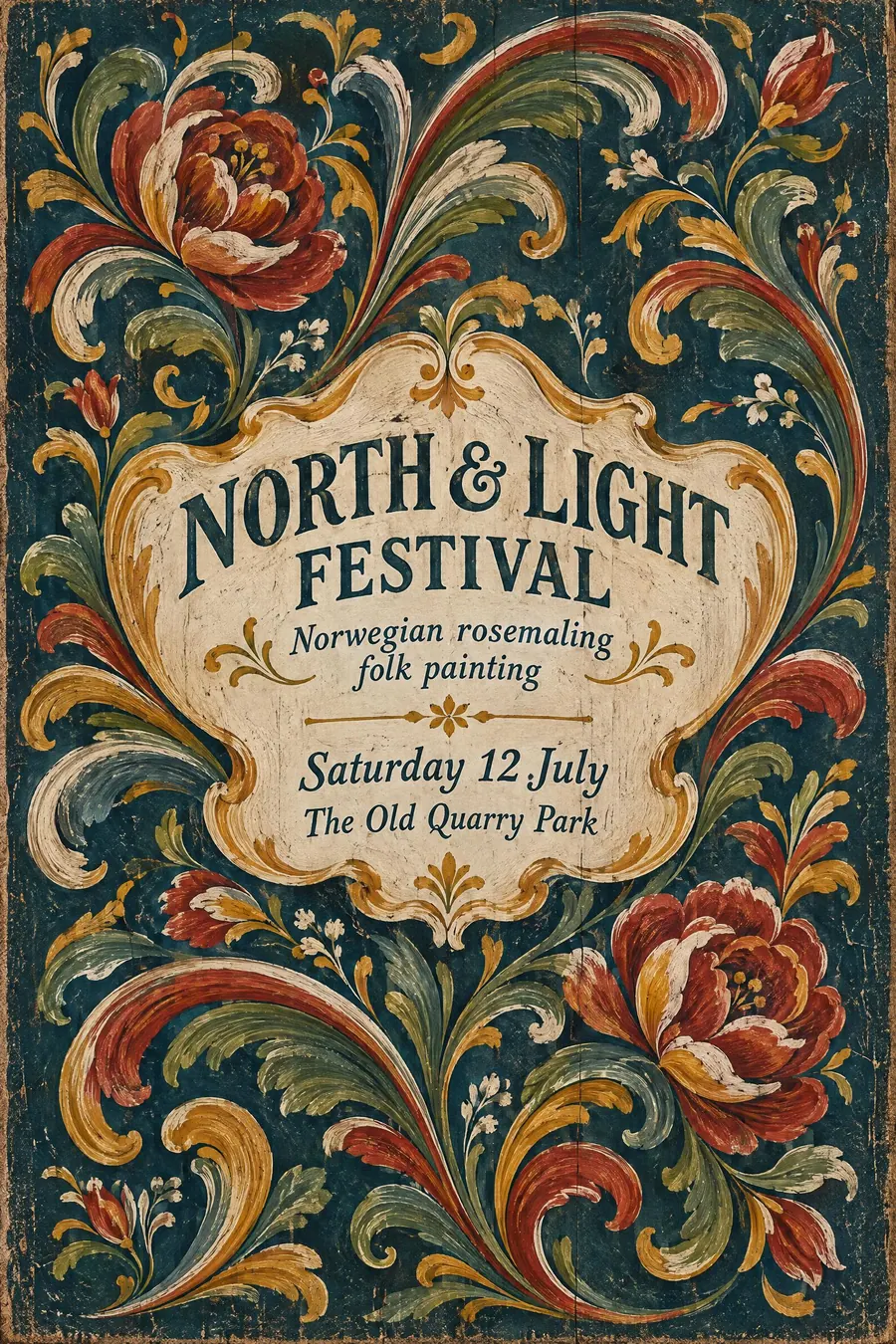
Flowing C and S scrolls of painted flowers, with a loaded brush and a visible highlight stroke.
Opens an image model with the prompt in it. The price is on the page before you sign in.
What it is for
Rosemaling is the warmest of the folk traditions here because the brush stroke is visible in every petal, so the whole surface looks alive.
It also scales down well. One scroll and a cartouche is enough, which suits a poster better than a full painted chest.
How it works
Grow the design from one root, flowing asymmetrically in C and S scrolls. It should look like it is moving.
Each stroke is made once with a loaded brush: a darker base colour, then a single light highlight stroke laid on top without mixing. That double stroke is the whole technique.
Paint on a dark ground, blue-green or barn red, with cream, white and mustard accents. Put the title in a hand-painted scroll cartouche and add worn painted wood texture.
When to use it
Use it for a Scandinavian event, a Christmas market, a folk music night, a craft fair, a bakery, a winter festival, a wedding.
Leave it alone for anything modern or minimal. It is dense, warm and traditional by nature.
Told apart from its neighbours
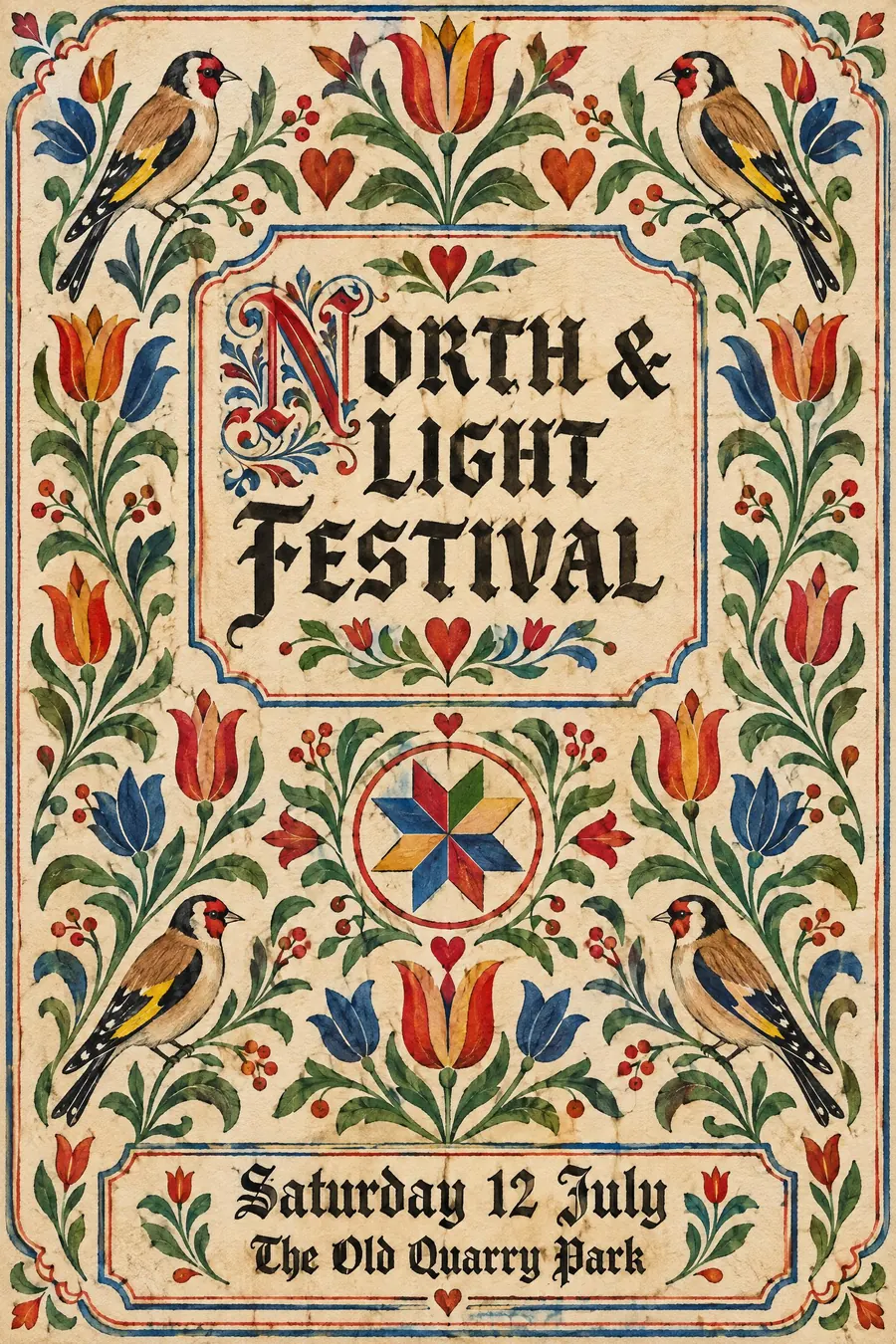
Fraktur is rigidly symmetrical and flat. Rosemaling flows asymmetrically and has brush modelling in every stroke.
Arts and Crafts repeats a flat pattern with a drawn outline. Rosemaling has no outlines at all.
Kurbits, the Swedish cousin, uses the same brushwork on a larger, simpler flower form.
Where it was used
Rosemaling spread through rural Norway from the 1750s, with Telemark and Hallingdal developing distinct styles. Emigrants took it to the American Midwest, where it survives on painted chests, bowls and the Vesterheim museum's annual competition.
- Telemark and Hallingdal painting
- painted Norwegian chests
- Swedish kurbits
The prompt
Replace the blanks with your own event, keep the rest. Then run it on an image model.
poster for <event>, Norwegian rosemaling folk painting, flowing asymmetric C and S scrolls of stylised roses and acanthus leaves growing from one root, each stroke made with a loaded brush showing a darker base and a single light highlight stroke on top, painted on a dark blue-green or barn red ground, cream white and mustard accents, a hand-painted scroll cartouche for the title, worn painted wood texture, <date, time and place> lettered inside the cartouche
What goes wrong
The model returns flat vector flowers. Ask for each stroke to be made with a loaded brush showing a dark base and one light highlight stroke on top.
The second failure is a symmetrical arrangement. Say the scrolls flow asymmetrically from a single root.
Leave out
flat vector colour, symmetry, hard outlines, pastel palette, digital smoothness
Watch for
Each petal is one brush stroke with a highlight. Outlined shapes filled with colour are not rosemaling.
Questions
Print it
Pay for the one run. No subscription, and the price is on the model page before you sign in.
Next to it in folk traditions